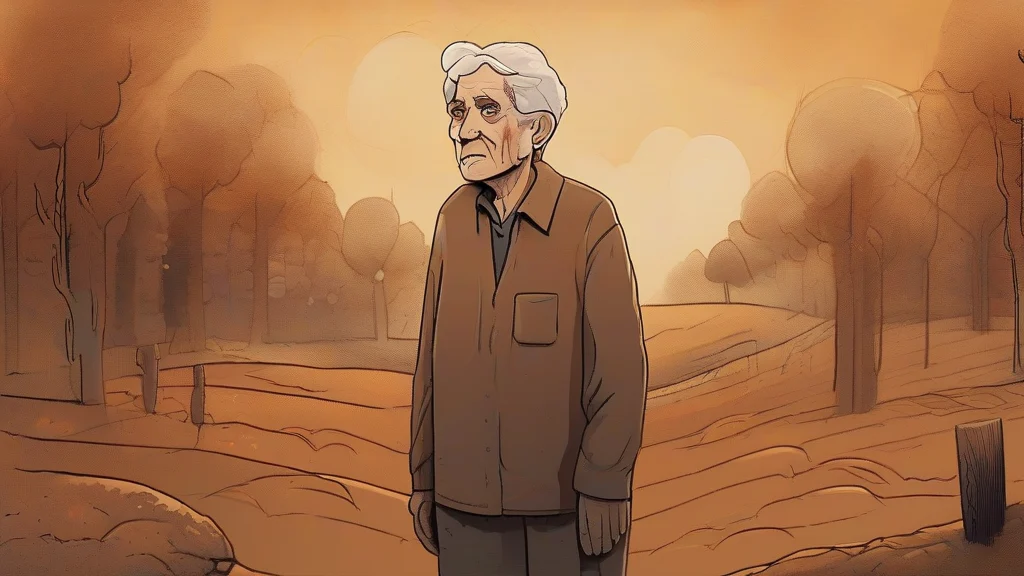
What does ageing mean?
Ageing refers to the natural process by which living things grow older, encompassing the gradual physical, mental, and biological changes that unfold over a lifetime. It appears most often as an uncountable noun describing this process — as in discussions of an ageing population or the visible signs of ageing — and also as the present participle of the verb 'to age'. Beyond biology, ageing applies to anything that matures or improves with time, such as wine, cheese, or whisky, where controlled ageing is a deliberate craft. The word carries neutral to slightly negative connotations when applied to people, often evoking concerns about health or appearance, though it can equally suggest wisdom and refinement. Spelled 'ageing' in British English and 'aging' in American English, it derives ultimately from Latin 'aetas', meaning age or lifetime. Its prominence has grown alongside demographic shifts, making it a key term in medicine, economics, and public policy.
The process of growing old; the gradual physical and biological changes associated with advancing age.
"Researchers studying ageing hope to understand why cells deteriorate over time."
Usually treated as an uncountable noun; in scientific writing, 'senescence' may be used for the underlying biological mechanisms.
Present participle of 'to age': undergoing the process of becoming older or more mature.
"The wine is still ageing in oak barrels and will not be bottled until next year."
Scientists still can't fully explain why we age — making 'ageing' one of biology's great unsolved mysteries hiding inside an everyday word.
Reviewed by Deb Chak, Editor. AI-assisted content curated by RJS Tech Solutions LLP.
Etymology of ageing
The word 'ageing' derives from 'age', which entered Middle English from Old French 'aage' (modern French 'âge'), itself descending from a Vulgar Latin form based on the Latin 'aetas', meaning age or period of life, from 'aevum' (lifetime, eternity). The present-participle form 'ageing' developed naturally as English speakers described the ongoing process of growing old. The spelling split between British 'ageing' and American 'aging' reflects broader differences in how the two varieties handle the softening 'e' before suffixes. Related words sharing this root include 'ageless', 'ageism', and 'coeval'.
Related word forms
How ageing is actually used
'Ageing' is the standard British spelling; American English overwhelmingly uses 'aging'. As a countable concept it usually functions as an uncountable noun referring to a process rather than a discrete entity. In scientific contexts, the term 'senescence' is often preferred for cellular or organismal decline.
Easily confused with ageing
'Aging' is simply the American spelling of the same word, while 'ageing' is the preferred British spelling — they mean exactly the same thing.