What does akee mean?
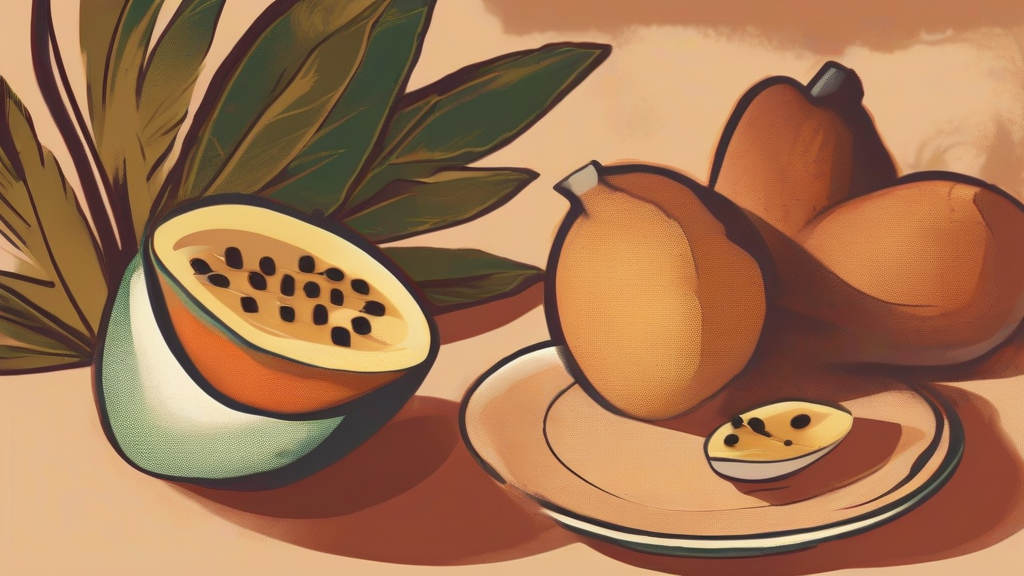
The akee is a tropical tree, Blighia sapida, native to West Africa and best known today as a cornerstone of Jamaican cuisine. Its fruit is a red or orange pod that splits open when fully ripe to reveal cream-colored arils attached to glossy black seeds; these arils, once cooked, have a mild, slightly nutty flavor often compared to scrambled eggs. The word entered English in the eighteenth century, borrowed from a language of the Gold Coast (likely Twi), and arrived in the Caribbean aboard ships associated with Captain William Bligh, whose name supplied the botanical epithet. Akee must be handled with care: eaten before the pod opens naturally, it contains the toxin hypoglycin A and can trigger severe poisoning known as Jamaican vomiting sickness. Cooked properly, however, it is beloved — most famously sautéed with salted cod in ackee and saltfish, Jamaica's national dish. In Jamaica the spelling "ackee" is standard, and the fruit holds such cultural weight that it features on the country's coat-of-arms-adjacent imagery and five-cent coin.
nounThe akee is a tropical West African tree (Blighia sapida) widely cultivated in the Caribbean, whose red pear-shaped fruit yields edible yellow arils when ripe but is toxic if eaten unripe.
- The edible aril of the akee fruit, eaten cooked as a staple food in Jamaican cuisine.
- The akee tree itself (Blighia sapida), native to West Africa and naturalized across the Caribbean.
"Jamaicans traditionally cook saltfish with akee to make the island's national dish."
"She simmered the akee gently with onions, tomatoes, and flaked saltfish for Sunday breakfast."
"The akee tree, brought across the Atlantic in the eighteenth century, now shades roadsides throughout Jamaica."
The plural is rare in practice, since akee usually refers to the prepared food or the tree species rather than counted individual fruits.
"The market stalls were piled high with fresh akees, their pods just beginning to split."
Named after Captain William Bligh of mutiny-on-the-Bounty fame, who carried the tree to Britain — and its unripe fruit can cause fatal 'Jamaican vomiting sickness.'
Reviewed by Deb Chak, Editor. AI-assisted content curated by RJS Tech Solutions LLP.
Etymology of akee
The word akee was borrowed into English in the eighteenth century from a language of the Gold Coast of West Africa, most likely Twi (an Akan language), where related forms name the same tree. It traveled to the Caribbean through the transatlantic slave trade era, and the tree itself reached Jamaica and Britain via voyages connected to Captain William Bligh — hence its scientific name, Blighia sapida. In modern usage the Jamaican spelling "ackee" has become dominant, though "akee" remains an accepted variant in dictionaries.
How akee is actually used
In Jamaica the spelling "ackee" predominates and the word carries strong national identity — it appears on coins and emblems alongside the national dish "ackee and saltfish." The fruit must be harvested only after the pod opens naturally on the tree; unripe akee contains hypoglycin A, which causes severe illness.
Easily confused with akee
"Ackee" is simply the more common spelling of the same word in Jamaica and much of the Caribbean, while "akee" is an alternative spelling used elsewhere.