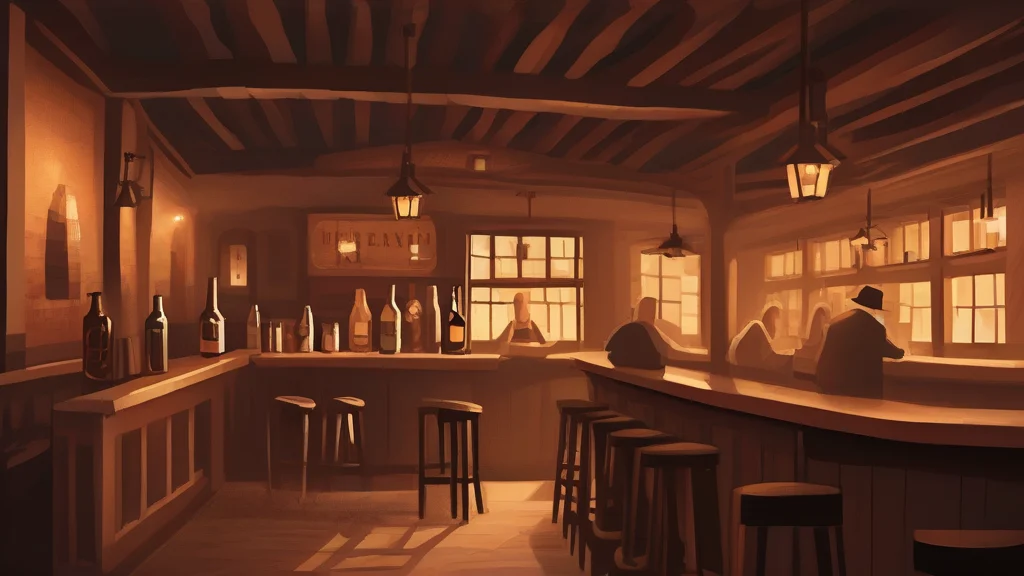
What does alehouse mean?
An alehouse is a drinking establishment where ale is sold and consumed, historically the most common kind of licensed premises in England. Emerging in the medieval period, alehouses were humble affairs — often private homes that brewed and sold ale to neighbours — and they served as vital centres of community life, news, and gossip long before the rise of the modern public house. Over time, as beer displaced ale and licensing laws evolved, the alehouse gave way to the tavern and eventually the pub, and today the word survives chiefly in historical writing, literature, and heritage contexts. It carries a distinctly rustic, old-world flavour: to say 'the village alehouse' is to evoke timber beams, open fires, and centuries of conviviality. Though rarely used in everyday conversation now, it remains a useful term for anyone reading English history or classic literature, where it appears constantly as shorthand for ordinary people's social world.
nounA tavern or public house where ale is sold and drunk; historically, an establishment licensed to serve ale.
- An establishment where ale (and later other drinks) is sold and consumed on the premises.
"The old alehouse at the crossroads had served travellers since Tudor times."
"After a long day in the fields, the labourers gathered at the village alehouse."
"Shakespeare's plays are full of alehouses, reflecting how central they were to Elizabethan social life."
Standard plural; commonly used in historical contexts, e.g. describing the density of alehouses in a town.
"By 1577, England recorded thousands of alehouses serving even its smallest villages."
Before there were pubs, there were alehouses — so many in medieval England that some villages had one for every dozen households.
Reviewed by Deb Chak, Editor. AI-assisted content curated by RJS Tech Solutions LLP.
Etymology of alehouse
Alehouse is a straightforward compound of 'ale' and 'house', formed in Middle English when ale was the staple drink of medieval England. The root word 'ale' derives from Old English 'ealu', a fermented malt beverage brewed without hops, which itself traces back to Germanic origins shared with related words across northern Europe. Alehouses proliferated from at least the late medieval period, and the compound noun became firmly established by the early modern era. Its Germanic cognates include the Old Norse and continental forms of 'ale', while the brewing trade gave rise to related terms such as 'alewife', denoting a woman who brewed ale commercially.
How alehouse is actually used
Alehouse is now largely historical or literary in tone, evoking pre-industrial England; the terms pub and bar have replaced it in everyday use. It carries a warm, rustic connotation rather than a negative one.
Easily confused with alehouse
An alehouse specifically sold ale and was the historical English predecessor of the modern pub, which serves a wider range of drinks and food.