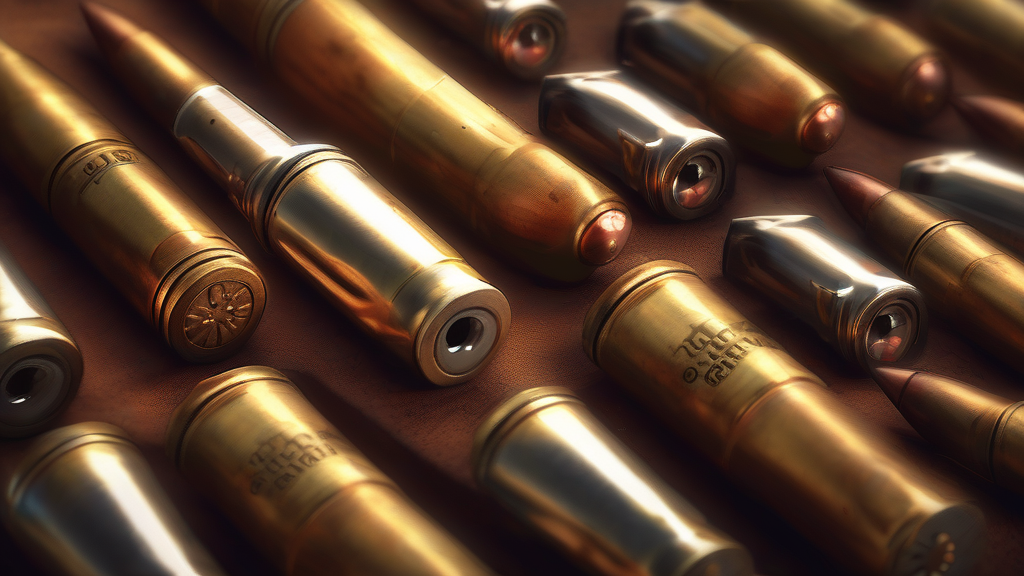
What does ammo mean?
Ammo is an informal, shortened form of the word ammunition, referring collectively to the projectiles — bullets, shells, rounds, and similar — fired from guns and other weapons, along with the propellants that drive them. Because it is a mass noun, it has no plural form; speakers say 'we ran out of ammo' rather than counting individual pieces. Though casual in register, the term appears widely in conversation, journalism, gaming, and film, where its clipped sound suits fast-paced contexts. Beyond the literal battlefield sense, ammo has developed a firmly established figurative use: facts, quotes, or arguments that can be deployed against an opponent are described as giving someone ammo, as in political debate or public controversy. The word derives from the same Latin root as 'ammunition' and 'munitions', tracing back through early modern French military terminology for supplies. Its blend of concrete weaponry and abstract argument makes it a versatile, vivid word in modern English.
Informal term for ammunition: projectiles such as bullets or shells, together with their propellants, used in firearms and other weapons.
"The troops were running low on ammo after the long firefight."
Uncountable noun; informal register.
Figuratively, facts or arguments used to support one's own case or undermine an opponent's.
"The report handed the opposition party plenty of ammo ahead of the election."
Common in political, legal, and sporting commentary.
'Ammo' is an uncountable (mass) noun and has no plural form; quantity is expressed with partitive phrases such as 'some ammo', 'plenty of ammo', or 'a box of ammo'.
"They stocked up on plenty of ammo before hunting season."
It started life as 17th-century French military jargon meaning 'provisions' — and today people fight verbal battles with it just as often as real ones.
Reviewed by Deb Chak, Editor. AI-assisted content curated by RJS Tech Solutions LLP.
Etymology of ammo
Ammo arose in English as an informal clipping of 'ammunition', which itself entered the language in the early 17th century from the French phrase 'la munition'. The French word derived ultimately from the Latin verb 'munire', meaning 'to fortify or provide', connected to 'munus' (duty or gift). The clipped form 'ammo' became common in 20th-century colloquial speech, particularly among soldiers, and later extended figuratively to mean rhetorical ammunition.
How ammo is actually used
'Ammo' is informal and colloquial; formal, journalistic, and military writing typically uses the full word 'ammunition'. It functions as an uncountable (mass) noun, so it takes no plural and pairs with quantifiers like 'some', 'plenty of', or 'a box of'. The figurative sense — arguments used as rhetorical ammunition — is well established and common in political and sports commentary.
Easily confused with ammo
'Ammo' is simply the informal, clipped everyday form of the fuller word 'ammunition', which is preferred in formal, military, or technical writing.