What does amphorae mean?
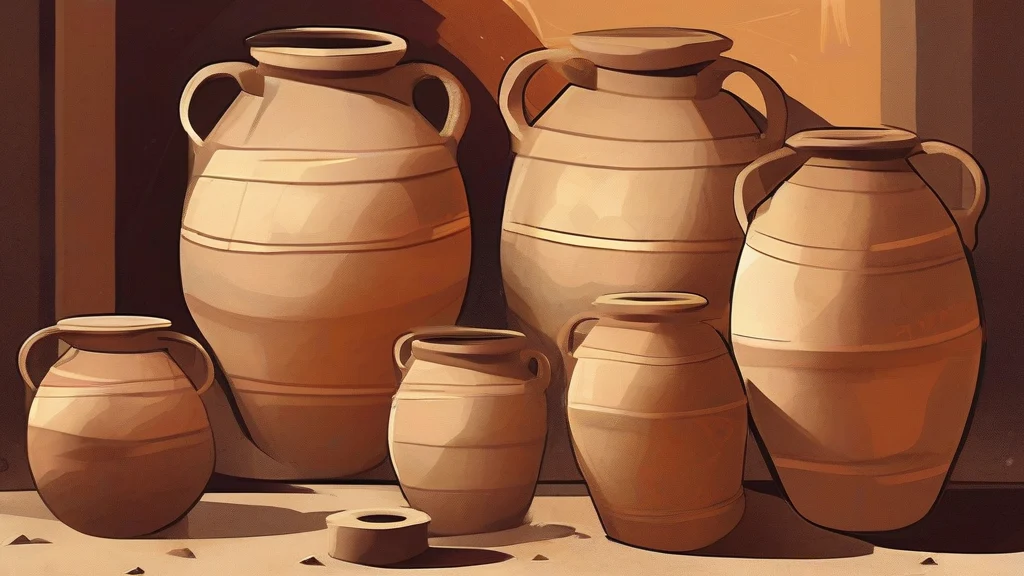
Amphorae are the distinctive large ceramic storage jars of the ancient Greek and Roman worlds, instantly recognizable by their two handles, narrow necks, and pointed bases that allowed them to be packed upright in sand or stacked snugly in a ship's hold. Produced in enormous quantities across the Mediterranean, they served as the shipping containers of antiquity, carrying wine, olive oil, grain, fish sauce, and other staples across vast trade networks. The term 'amphorae' is simply the plural of 'amphora', borrowed from Latin and ultimately from Greek, where it literally meant something carried on 'both sides'. Today the word appears chiefly in archaeology, history, and museum contexts; scholars even classify amphorae by shape, fabric, and origin to date wrecks and trace ancient commerce. Because so many survive intact beneath the sea, amphorae remain one of the most abundant and informative classes of artefact from the classical world.
noun (plural of amphora)Amphorae are large ancient Greek and Roman ceramic storage jars, typically with two handles and a narrow neck, used for transporting and storing wine, oil, grain, and other commodities.
- The plural form of amphora: large two-handled ceramic jars used by ancient Greek and Roman civilizations for storing and transporting goods such as wine, olive oil, and grain.
"The museum's basement held rows of Roman amphorae recovered from a shipwreck off the coast of Sicily."
"Archaeologists catalogued more than two hundred amphorae at the underwater excavation site."
"Each amphora was stamped with the maker's mark before being loaded onto the merchant vessel."
As 'amphorae' is already a plural noun, it takes plural verbs; the singular is 'amphora'. The Latin-style plural is preferred in academic and archaeological writing, while 'amphoras' is common in general usage.
"Hundreds of amphorae were recovered from the seabed near the ancient harbour."
Ancient shipwrecks are often found carpeted with hundreds of amphorae — some Mediterranean wrecks carried as many as 10,000 of these clay jars in a single hold.
Reviewed by Deb Chak, Editor. AI-assisted content curated by RJS Tech Solutions LLP.
Etymology of amphorae
The word derives from Latin 'amphora', itself borrowed from Greek 'amphoreus' or 'amphiphoreus', formed from 'amphi-' ('on both sides') and 'phoreus' ('bearer'), a reference to the jar's two carrying handles. It entered English in the late Middle English period through Latin, and the Latinate plural 'amphorae' remains standard in scholarly writing alongside the anglicized 'amphoras'. Cognate formations using the same Greek root include 'amphipod', an animal whose limbs are borne on both sides of its body.
Related word forms
How amphorae is actually used
'Amphorae' is the classical Latinate plural; 'amphoras' is also an accepted anglicized plural. The word appears mainly in archaeological, historical, museum, and academic writing rather than everyday conversation.
Easily confused with amphorae
'Amphora' is the singular form referring to one jar, while 'amphorae' is its plural, referring to two or more such vessels.