
What does anacardium mean?
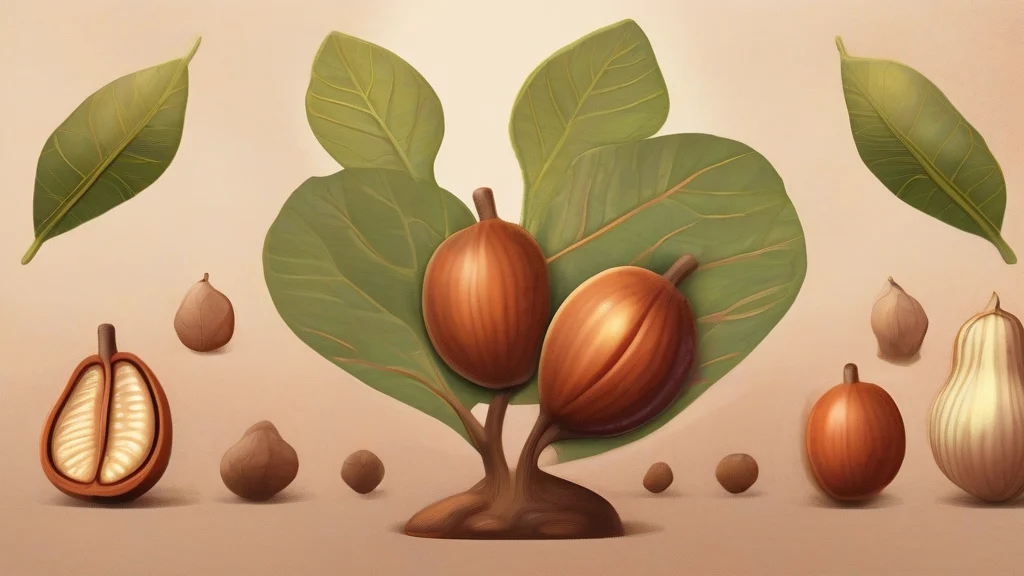
Anacardium is a botanical genus name for a group of tropical trees and shrubs belonging to the cashew family, Anacardiaceae. Its best-known member by far is Anacardium occidentale, the cashew tree, cultivated throughout the tropics for its kidney-shaped edible seed. The genus name derives from the Greek anakardia, formed from kardia ('heart'), a reference to the heart-like appearance of the fruit noted by early writers. Beyond botany, the capitalized name Anacardium also survives in homeopathy, where a remedy prepared from the markings nut (Anacardium orientale) has long been listed in materia medica. Because it is a formal scientific term, anacardium rarely appears in casual conversation; speakers normally use 'cashew' instead. It is nevertheless a useful word for anyone reading botanical, agricultural, or historical accounts of tropical crops, where the Latin binomial remains the precise way to identify the plant.
nounA genus of flowering trees and shrubs in the cashew family (Anacardiaceae), native to tropical regions of the Americas; it includes the cashew tree (Anacardium occidentale).
- A genus of tropical trees and shrubs in the family Anacardiaceae, most famously including the cashew tree (Anacardium occidentale).
- In homeopathy, a remedy prepared from the markings nut (Anacardium orientale), used in highly diluted preparations.
"The cashew tree, botanically known as Anacardium occidentale, was carried from Brazil to India by Portuguese traders in the sixteenth century."
"Botanists classify the cashew tree under the genus Anacardium, which takes its name from the Greek word for heart."
"In homeopathic practice, Anacardium orientale, derived from the markings nut, is among the more frequently prescribed remedies."
The Latinized plural anacardia follows the neuter plural pattern of second-declension nouns ending in -um, but it is rarely used; writers typically refer to individual species or simply treat anacardium as a singular taxonomic name.
"Several species within the genus Anacardium remain poorly studied compared with the widely cultivated cashew."
The cashew got its scientific name from a heart: 'Anacardium' literally means 'heart-shaped', because early botanists thought the swollen cashew apple looked like one.
Reviewed by Deb Chak, Editor. AI-assisted content curated by RJS Tech Solutions LLP.
Etymology of anacardium
The word anacardium comes from the Greek anakardia, itself derived from kardia, meaning 'heart', because ancient writers described the plant as having heart-shaped fruit. The Greek term passed into Latin as anacardium, and Linnaeus adopted this classical name when he formally established the genus in the eighteenth century. The same root kardia gives English many medical and scientific words such as cardiac, cardiology, pericardium, and myocardium.
Related word forms
How anacardium is actually used
Anacardium is primarily a scientific and botanical term rather than an everyday word; in ordinary speech people say 'cashew' or 'cashew tree'. It appears mainly in botanical literature, horticultural writing, and homeopathic texts, where the capitalized binomial form Anacardium occidentale is standard.
Easily confused with anacardium
Anacardium is a single genus of plants, whereas Anacardiaceae is the larger family that contains Anacardium along with mangoes, pistachios, and sumacs.