
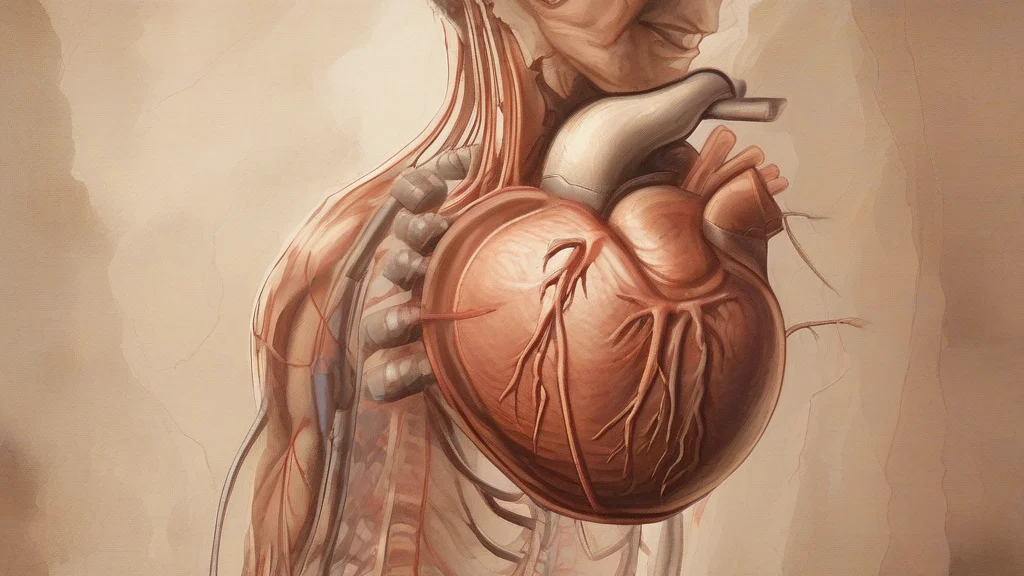
What does myocardium mean?
The myocardium is the heart's muscular tissue, forming the thick middle layer of the heart wall and generating the contractions that pump blood through the lungs and around the body. Although it may resemble an ordinary muscle, the myocardium has a distinctive rhythm of activity: it contracts and relaxes continuously throughout life, with its rate adjusting to the body's changing demands for oxygen and blood. Damage to this tissue can impair the heart's ability to pump effectively, which is why myocardial infarction, or heart attack, is a serious medical condition. In general use, “heart muscle” or “cardiac muscle” is more accessible than the formal term. Myocardium is especially useful in medicine, anatomy, and cardiology, where precise distinctions between the heart's muscular wall, inner lining, and outer covering matter. The word also reveals the structure of several related medical terms through the combining forms myo-, meaning muscle, and cardi-, meaning heart.
nounThe myocardium is the muscular tissue that forms the substance of the heart and contracts to pump blood through the circulatory system.
- The muscular tissue forming the substance of the heart.
"The scan revealed reduced blood flow and damage to the myocardium."
"An echocardiogram showed reduced blood flow through the myocardium."
"The biopsy revealed scar tissue in the myocardium of the left ventricle."
The plural myocardiums is straightforward, while myocardia reflects the Latin plural ending and occurs in specialized medical writing.
"The investigators compared myocardiums obtained from three patients."
The prefix myo- means “muscle,” so myocardium literally means “heart muscle”—the powerful tissue that never stops working.
Reviewed by Deb Chak, Editor. AI-assisted content curated by RJS Tech Solutions LLP.
Where does myocardium come from?
Myocardium was formed in Modern Latin from the Greek myokardios, meaning “heart muscle,” a compound of mys, “muscle,” and kardia, “heart.” The term entered medical use in the late nineteenth century and developed alongside related forms such as myocardial and cardiomyopathy. Its components continue in words including myocyte, a muscle cell, and cardiac, relating to the heart.
Related word forms
How myocardium is actually used
This is a specialized medical and anatomical term. General prose usually calls it heart muscle or cardiac muscle, while myocardial is the corresponding adjective commonly used in clinical expressions.
Easily confused with myocardium
The myocardium is the heart's muscular tissue, whereas the pericardium is the sac-like connective tissue surrounding the heart.
The myocardium forms the bulk of the heart's muscular wall, while the endocardium is the thin inner lining of the heart chambers.