
What does andradite mean?
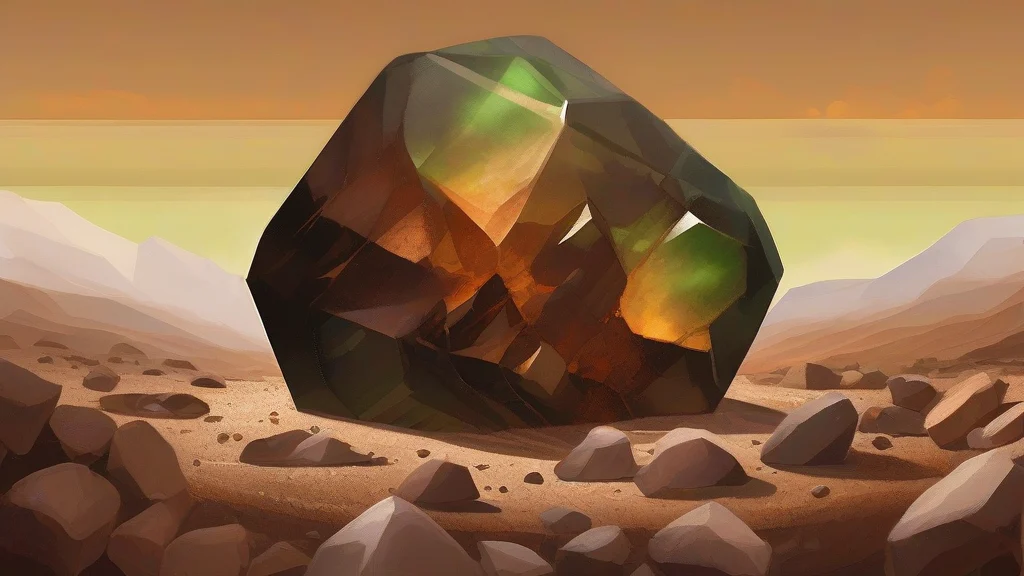
Andradite is a mineral belonging to the garnet group, a calcium iron silicate with the chemical formula Ca3Fe2(SiO4)3. It takes its name from the Portuguese mineralogist José Bonifácio de Andrada e Silva, who first described it in the early nineteenth century. Andradite occurs in several well-known varieties: melanite, a striking opaque black form; topazolite, a yellowish form resembling topaz; and demantoid, a brilliant green variety that ranks among the most valuable of all garnets. Found in skarn deposits, serpentinites, and other metamorphic rocks, andradite is prized chiefly as a collector's mineral and, in its finer forms, as a gemstone. The word appears mainly in mineralogical, geological, and jewellery contexts, where precision about which garnet species is meant matters. For readers interested in gems, andradite offers a memorable example of how one chemical composition can produce stones ranging from jet black to vivid green.
nounA calcium-iron silicate mineral of the garnet group, typically black, brown, or green, valued as a gemstone in its varieties demantoid and topazolite.
- A calcium-iron silicate mineral of the garnet group (Ca3Fe2(SiO4)3), occurring in varieties such as melanite (black) and demantoid (green).
- A gemstone cut from any of these garnet varieties.
"The jeweller set a vivid green demantoid, the finest variety of andradite, into an antique gold ring."
"The museum's collection included a striking specimen of black andradite from the Italian Alps."
"Collectors prize demantoid, the green variety of andradite, above almost all other garnets."
Rarely used; specimens are usually referred to individually or by variety.
"The case displayed andradites of every colour from jet black to deep green."
Named after a Portuguese mineralogist, this garnet's rarest green variety — demantoid — was so brilliant it was once mistaken for diamond by Russian tsarist jewellers.
Reviewed by Deb Chak, Editor. AI-assisted content curated by RJS Tech Solutions LLP.
Etymology of andradite
Andradite was named in honour of the Portuguese statesman and mineralogist José Bonifácio de Andrada e Silva, who described the mineral in the early nineteenth century. It belongs to the garnet family, whose members share related names drawn from mineralogy rather than a common linguistic root. Its name entered scientific literature through European mineralogy and has remained stable since.
How andradite is actually used
Primarily used in mineralogy, geology, and gemmology; rarely encountered in everyday speech.
Easily confused with andradite
Demantoid andradite is a green garnet that can resemble emerald, but emerald is beryl and much softer in lustre classification.