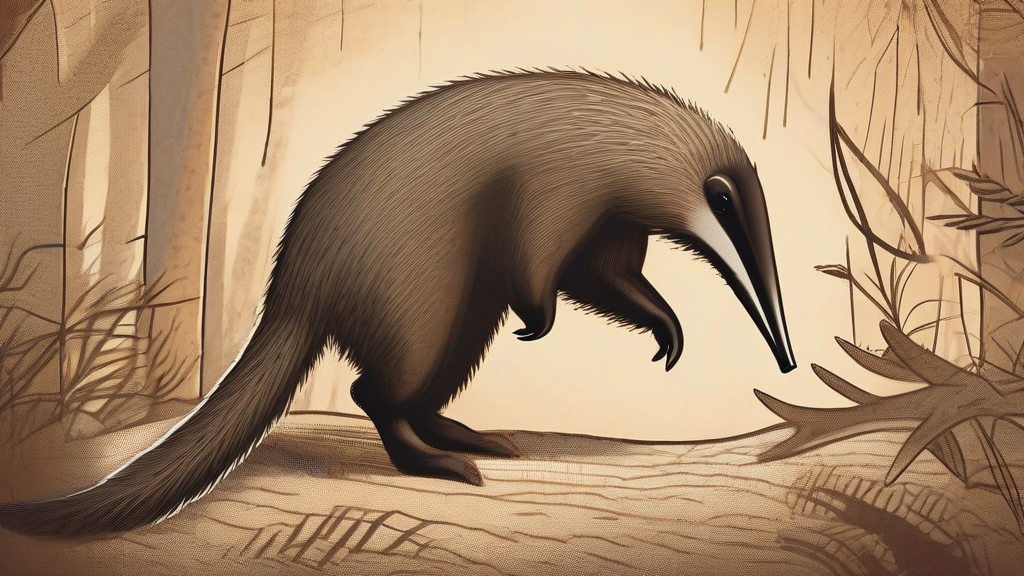
What does anteater mean?
An anteater is a distinctive mammal adapted to feed almost exclusively on ants and termites. The name most precisely applies to the four species of Central and South America: the giant anteater and three smaller tamanduas, all equipped with elongated snouts, long sticky tongues, and strong curved claws used to tear open insect nests. Because they lack teeth, anteaters crush their food against hardened ridges in the mouth. The label 'anteater' is also applied informally to other insect-eating animals, such as Australia's numbat and the egg-laying echidna, though these are not closely related. In everyday speech the word carries little figurative weight; it functions as a straightforward zoological term, instantly conjuring an image of the shuffling, long-nosed creature of grasslands and forests. It appears frequently in nature writing, children's books, and general science journalism, where it stands as one of the more recognizable examples of evolutionary specialization.
nounA mammal that feeds primarily on ants and termites, especially the giant anteater of Central and South America, characterized by a long snout, sticky tongue, and powerful claws for tearing open insect nests.
- Any of several toothless or nearly toothless mammals of Central and South America that feed chiefly on ants and termites, especially the giant anteater.
- Loosely, any animal with a comparable ant-eating diet, such as the numbat or echidna.
"The anteater ripped open the termite mound and lapped up thousands of insects with its two-foot tongue."
"At the zoo, visitors watched the anteater probe the log with its slender snout in search of insects."
"Though it looks fearsome, the anteater poses little threat to humans unless cornered."
Standard plural; used when referring to multiple individuals or to the group collectively.
"Anteaters roam the savannas and forests of South America in search of insect colonies."
A giant anteater can devour up to 30,000 ants and termites in a single day — using a tongue that flicks in and out around 150 times per minute.
Reviewed by Deb Chak, Editor. AI-assisted content curated by RJS Tech Solutions LLP.
Etymology of anteater
The word 'anteater' is an English compound formed from the noun 'ant' plus 'eater', first appearing in English in the early 17th century as European naturalists described the strange creatures of the New World. It belongs to a family of descriptive animal names built on feeding habits, alongside terms like 'flycatcher' and 'honeyeater'. Although 'ante-' resembles the Latin prefix meaning 'before', this is coincidental: the word derives simply from the insect name 'ant', whose own etymology traces to Old English 'æmette'.
How anteater is actually used
The term 'anteater' most strictly refers to the four species of the suborder Vermilingua — the giant anteater and three tamanduas — but is often applied loosely to unrelated animals such as the numbat ('banded anteater') and the spiny anteater (echidna). In everyday usage the word typically evokes the striking image of the giant anteater.
Easily confused with anteater
An aardvark is an African mammal with similar diet and habits but is entirely unrelated to the anteaters of Central and South America.