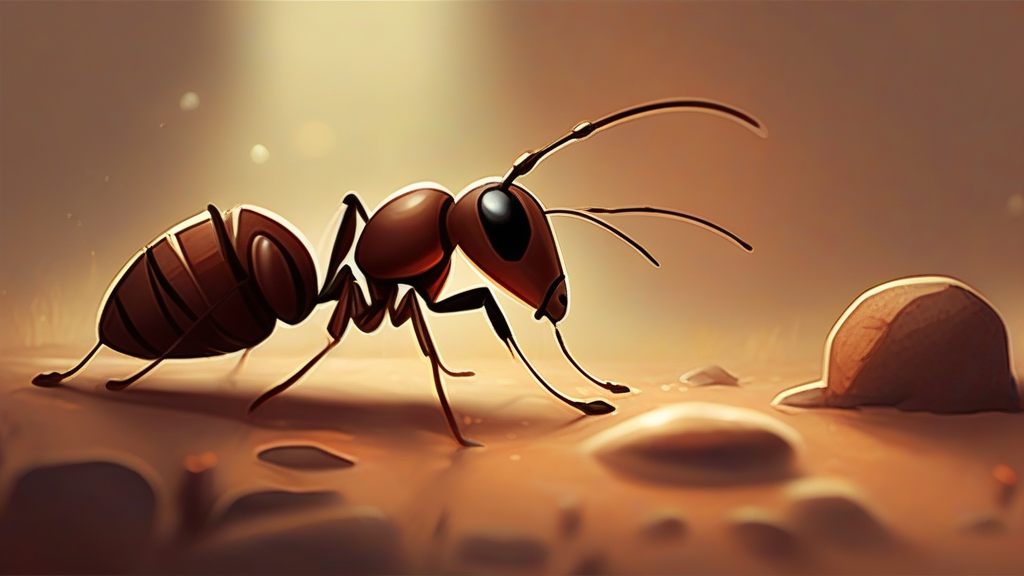
What does ant mean?
An ant is a small, usually wingless insect belonging to the family Formicidae, renowned for its highly organized colonial life. Ants live in structured communities containing queens, workers, and sometimes soldiers, cooperating to forage, build nests, and raise young. The word appears constantly in everyday language — describing kitchen invasions, garden pests, or marvels of nature — and carries no strong connotation beyond its associations with industriousness and collective effort, which have made it a staple metaphor for hard work and teamwork. Because ants are among the most successful organisms on Earth, found on every continent except Antarctica, the word is universally familiar across the English-speaking world. Its pronunciation overlaps with 'aunt' in some dialects, making it a classic example of sound-alike confusion. Simple, ancient, and endlessly useful, 'ant' remains one of the most durable words in common English usage.
nounA small, typically wingless social insect of the family Formicidae that lives in organized colonies and is known for its strength relative to its size.
- A small social insect of the family Formicidae living in organized colonies.
"The picnic was overrun by ants within minutes of the food being laid out."
"A line of ants marched across the kitchen counter toward the sugar bowl."
"The leafcutter ants stripped the garden's rose bushes overnight."
Standard pluralization; no irregular forms exist.
"Ants swarmed over the fallen apple."
An ant can carry objects many times its own body weight — pound for pound, one of the strongest creatures on Earth.
Reviewed by Deb Chak, Editor. AI-assisted content curated by RJS Tech Solutions LLP.
Etymology of ant
The word 'ant' descends from Old English 'ǣmette', meaning the same insect, which itself traces back to Proto-Germanic roots shared with related Germanic terms such as German 'Ameise' and Dutch 'mier'. In Middle English the form stabilized as 'amete' or 'amtes' before settling into the modern spelling 'ant'. An older dialectal survival of the same lineage is 'emmet', still heard in parts of southwestern England, while 'pismire' arose later as a folk compound referring to anthills. The word has remained remarkably stable in meaning for over a thousand years.
Related word forms
How ant is actually used
Entirely neutral register; used in everyday speech, children's literature, and scientific writing alike. In some British dialects, especially West Country, the older word 'emmet' survives as a regional alternative.
Easily confused with ant
An 'ant' is an insect, while an 'aunt' is the sister of one's parent — they share nearly identical pronunciation in some dialects but entirely unrelated meanings.