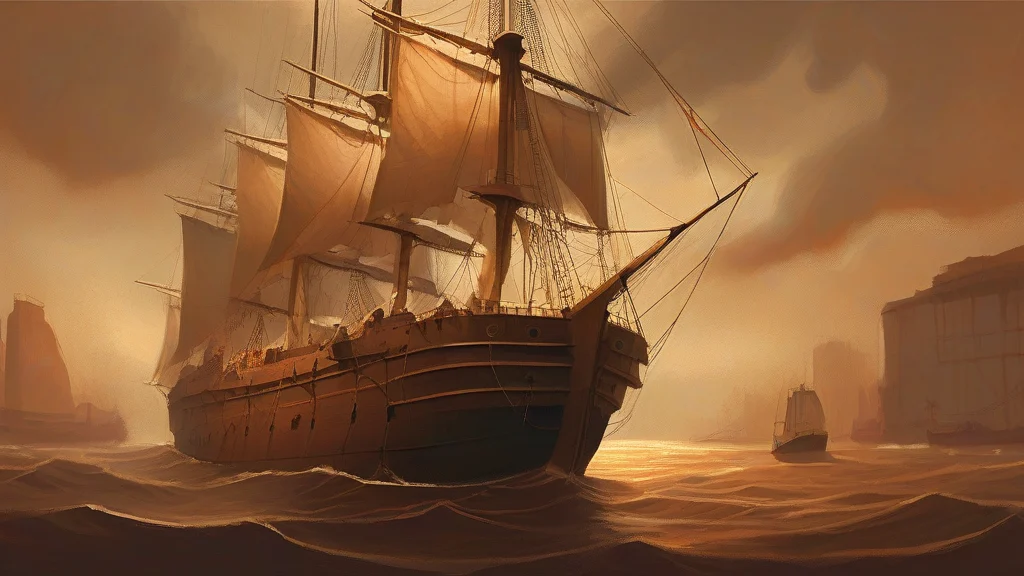
What does argosy mean?
An argosy is a large merchant ship, particularly one of the richly laden trading vessels that sailed between Renaissance Italy and the eastern Mediterranean, and by extension it can mean a whole fleet of such ships. The word entered English in the sixteenth century, borrowed from Italian, and quickly became a byword for commercial wealth afloat — a single argosy's cargo might represent a fortune in spices, silks, or grain. Today it survives chiefly in literary and historical writing, where it lends a passage an air of romance and antiquity; few readers encounter it outside novels, poetry, and accounts of maritime history. Its most celebrated appearance is in Shakespeare's The Merchant of Venice, where Antonio's fortunes rest upon his argosies scattered across the seas. For writers seeking an evocative alternative to plain terms like freighter or cargo ship, argosy remains a distinctive choice.
nounA large merchant ship, especially one sailing richly laden; by extension, a fleet of such ships.
- A large merchant ship, especially one richly laden with cargo.
- A fleet of merchant ships.
"The harbour was crowded with argosies unloading silk and spices from the East."
"A single rich argosy arriving from the Levant could make a merchant's fortune overnight."
"The port lay quiet until dawn, when an argosy of grain ships finally stood in past the headland."
The standard plural simply adds -es, following the regular pattern for nouns ending in -y preceded by a consonant.
"Antonio's argosies were dispersed across every sea, each one bound home with treasure."
Shakespeare gave the word its most famous cameo: in The Merchant of Venice, anxious Antonio's fortunes ride on 'argosies with portly sail' scattered across the seas.
Reviewed by Deb Chak, Editor. AI-assisted content curated by RJS Tech Solutions LLP.
Etymology of argosy
Argosy comes from Italian, ultimately deriving from 'ragusea', meaning a ship of Ragusa (modern Dubrovnik), whose merchant vessels were renowned in the medieval Mediterranean. The Italian term was reshaped in English, possibly influenced by association with Argos, the Greek city, giving the form we know today. It has been part of English since at least the sixteenth century and appears memorably in Shakespeare's The Merchant of Venice.
How argosy is actually used
Argosy is now largely literary and historical, evoking the great trading vessels of the Renaissance Mediterranean. It carries romantic, old-world connotations of wealth and maritime adventure rather than describing modern shipping.
Easily confused with argosy
An argosy is a large merchant ship (or fleet), while an odyssey is a long, eventful journey or voyage, often one filled with wanderings and adventures.