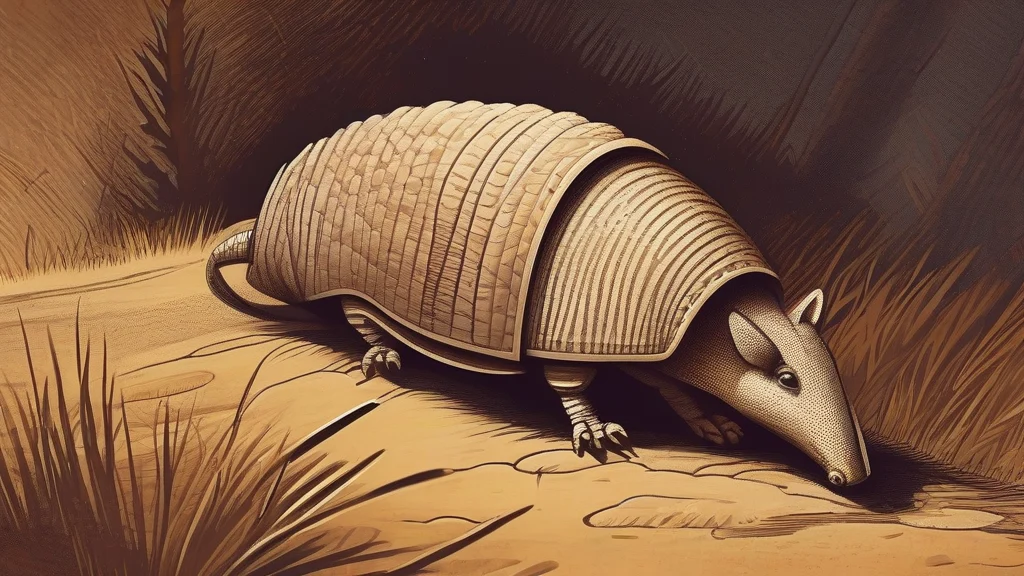
What does armadillo mean?
An armadillo is any of several burrowing, nocturnal mammals of the family Dasypodidae, found throughout the Americas and instantly recognisable by the bony armour plates that cover the back, head, legs, and tail. The name comes from Spanish, meaning 'little armoured one', reflecting the animal's most striking feature. Armadillos feed mainly on insects and grubs, digging with powerful claws, and many species can curl into a ball when threatened, though only some do so effectively. The nine-banded armadillo is the best-known species in the United States, famous both for its expanding range and for its unusual habit of producing identical quadruplets. In everyday English the word is used straightforwardly to refer to these animals, appearing in nature writing, wildlife documentaries, and conversation about American fauna. It carries no strong connotation beyond curiosity and charm, making it a memorable and distinctive word.
nounA burrowing, nocturnal mammal of the family Dasypodidae, native to the Americas, whose body is covered with a protective armour of bony plates; also used figuratively for anything resembling this armour.
- Any of various burrowing mammals of the family Dasypodidae, native to the Americas, protected by bony armour plates.
"The armadillo curled into a tight ball as the truck rumbled past."
"At dusk we watched an armadillo snuffling through the leaf litter for insects."
"The nine-banded armadillo has been steadily expanding its range northward into the United States."
The standard plural is 'armadillos'. The older form 'armadilloes', following Spanish convention, is now rarely seen.
"Armadillos have spread across much of the southeastern United States over the past century."
The nine-banded armadillo almost always gives birth to identical quadruplets — four genetically identical pups from a single fertilised egg.
Reviewed by Deb Chak, Editor. AI-assisted content curated by RJS Tech Solutions LLP.
Etymology of armadillo
The word 'armadillo' was borrowed from Spanish in the late sixteenth or early seventeenth century, where it literally means 'little armed one', from 'armado', meaning 'armed', ultimately derived from Latin 'armare', 'to arm'. It entered English through accounts of Spanish explorers in the Americas who encountered these strange armoured creatures. The same Latin root gives English words such as 'armour', 'armada', and 'armature'.
How armadillo is actually used
The word is used almost exclusively for the animal; figurative uses are rare. In casual speech it is often shortened informally to 'dillo' in parts of the southern United States. Plural is standard 'armadillos'; the older Spanish-style plural 'armadilloes' is now rare.
Easily confused with armadillo
A pangolin is a scaly anteater of Africa and Asia covered in keratin scales, whereas an armadillo is an American mammal armoured in bony plates.