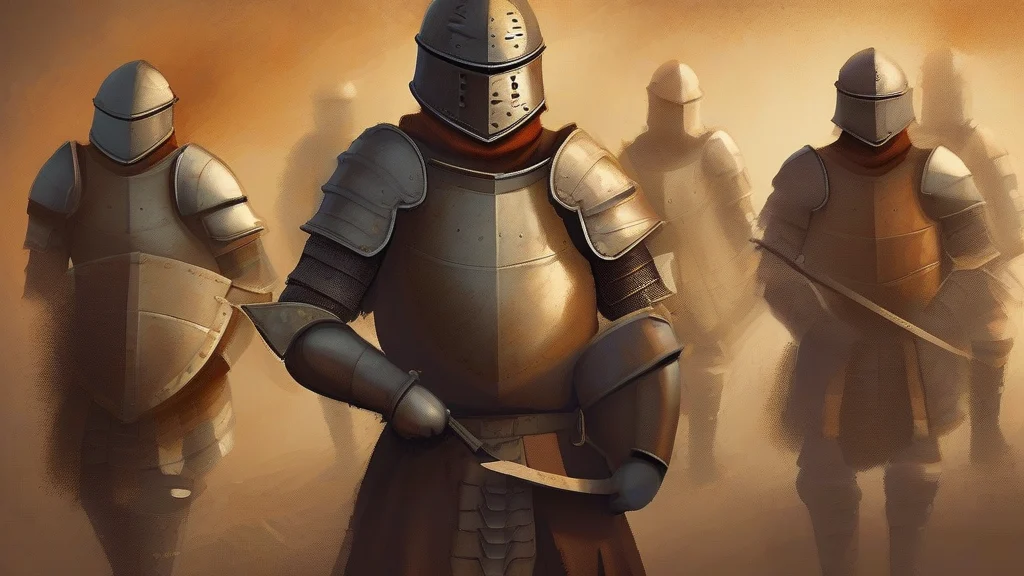
What does armour mean?
Armour refers to protective covering — historically the metal plates, chain mail, and leather worn by warriors and their horses to deflect blows in combat, and by extension the hardened plating fitted to tanks, warships, and aircraft. The word derives from Latin 'arma', meaning weapons or tools of war, and entered English through Old French. Beyond its military sense, armour is frequently used figuratively: an animal's shell may be called its natural armour, and a person's emotional defences are often described as armour against the world. The image of the 'knight in shining armour' has made the word a lasting cultural symbol of chivalry and protection. British English spells it 'armour', while American English prefers 'armor'; both spellings denote exactly the same word. Related terms include the armourer, who made and repaired suits of armour, and the armoury, where weapons were stored.
nounArmour is the protective metal or other hard covering worn by soldiers or horses in battle, or fitted to vehicles and ships to shield them from attack. It can also refer more broadly to any protective layer or defensive quality.
- Defensive metal covering worn by soldiers or horses, or fitted to warships, tanks, and other military vehicles.
- Any protective covering or defensive layer, literal or figurative (e.g. an animal's shell described as natural armour).
"The medieval knight's armour gleamed in the morning sun as he mounted his horse."
"The museum's collection includes a complete suit of jousting armour from the fifteenth century."
"The tank's armour was thick enough to withstand a direct hit."
The plural 'armours' is rare in everyday use; the uncountable sense ('suit(s) of armour', 'pieces of armour') is far more common.
"The castle's display cases held several armours from different centuries."
A full suit of plate armour weighed around 25 kilograms — yet a well-fitted suit distributed the weight so evenly that knights could run, mount horses, and even do cartwheels.
Reviewed by Deb Chak, Editor. AI-assisted content curated by RJS Tech Solutions LLP.
Etymology of armour
Armour comes from the Latin 'arma', meaning arms or weapons of war, which passed into Old French as 'armure' before entering Middle English in the medieval period. It is thus a cousin of words like 'armament' and 'armoury', all tracing back to the same Latin root. The spelling with '-our' reflects the French influence retained in British English, while American English simplified it to 'armor' in the same way as 'colour' became 'color'.
Related word forms
How armour is actually used
In British English 'armour' is standard; American English uses 'armor'. The word carries connotations of both physical protection and emotional defensiveness — writers often use it metaphorically, as in 'her cheerful manner was a kind of armour.'
Easily confused with armour
'Armor' is simply the American spelling of the same word, while 'armour' is the British spelling — they are not different words.
An armada is a fleet of warships, whereas armour is protective covering for people, animals, or vehicles.