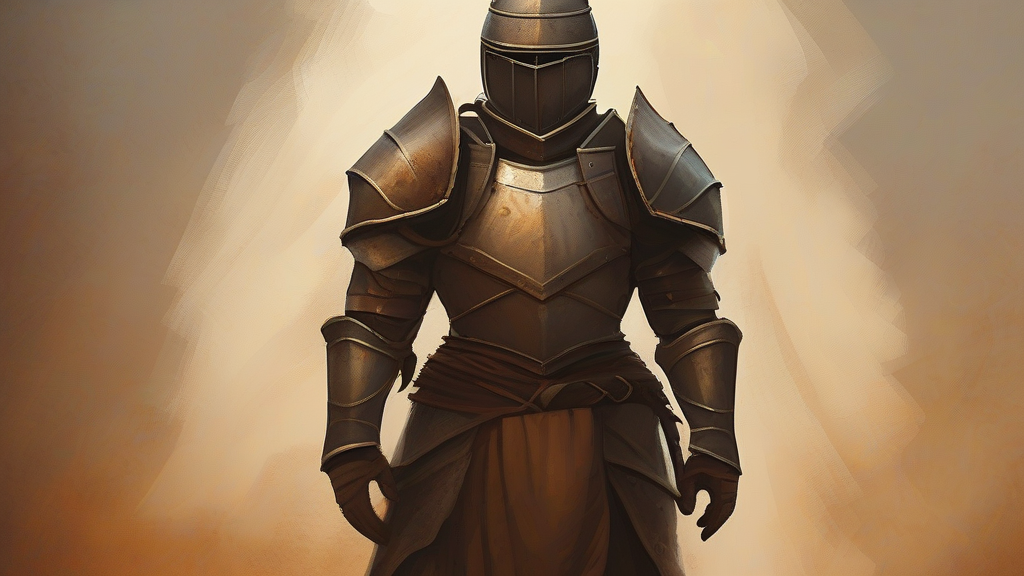
What does armor mean?
Armor is defensive covering designed to protect the body against weapons, most famously the metal plate and chain mail worn by knights and soldiers from antiquity through the medieval period. By extension, the word describes the hardened steel plating that protects tanks, warships, and other military vehicles, as well as modern personal protection such as body armor worn by police and soldiers. Armor also carries a rich figurative meaning: people are said to wear 'emotional armor' when they guard themselves against criticism, rejection, or pain. The word evokes strength, preparedness, and impenetrability, which makes it a favorite of metaphor in literature and everyday speech. Spelled 'armor' in American English and 'armour' in British English, it functions mainly as a noun but can act as a verb meaning to equip with protection. Its enduring presence in phrases like 'knight in shining armor' keeps it vividly alive in the modern imagination, long after battlefield steel gave way to kevlar and composite plating.
Protective covering worn on the body to defend against weapons, or hardened plating fitted to military vehicles and vessels.
"The foot soldier wore a padded jacket beneath his armor."
In British English, spelled 'armour' and pronounced /ˈɑːmə/.
A person's or organization's psychological defenses against emotional harm or attack.
"Her sharp wit was the armor she wore into every boardroom."
To equip with protective covering or armor plating (chiefly North American usage).
"The army decided to armor its transport convoys before the mission."
This verbal use is primarily found in American English.
As an uncountable mass noun referring to material, 'armor' is usually used without a plural. The plural 'armors' appears mainly when referring to distinct varieties or suits of armor.
"The collection includes armors from several different European traditions."
The phrase 'knight in shining armor' survives from an age when polished steel was literally a warrior's second skin — and modern soldiers still wear body armor descended from that same idea.
Reviewed by Deb Chak, Editor. AI-assisted content curated by RJS Tech Solutions LLP.
Etymology of armor
Armor comes from the Latin 'arma', meaning tools, weapons, or implements of war, via Old French 'armure'. It entered Middle English around the thirteenth century, initially alongside the native term 'harness' before largely displacing it. It shares this Latin root with related words like 'armament', 'armada', and 'armistice', all ultimately tied to the idea of arming for conflict. The British spelling 'armour' preserves the French-influenced -our ending that American English later simplified to -or.
Related word forms
How armor is actually used
Spelled 'armor' in American English and 'armour' in British English, following the standard -or/-our split. As a verb ('to armor a vehicle'), it is chiefly North American. The figurative sense of emotional or psychological 'armor' is common in modern writing and speech.
Easily confused with armor
'Armour' is simply the British English spelling of the same word, while 'armor' is the American spelling — they are not different words.