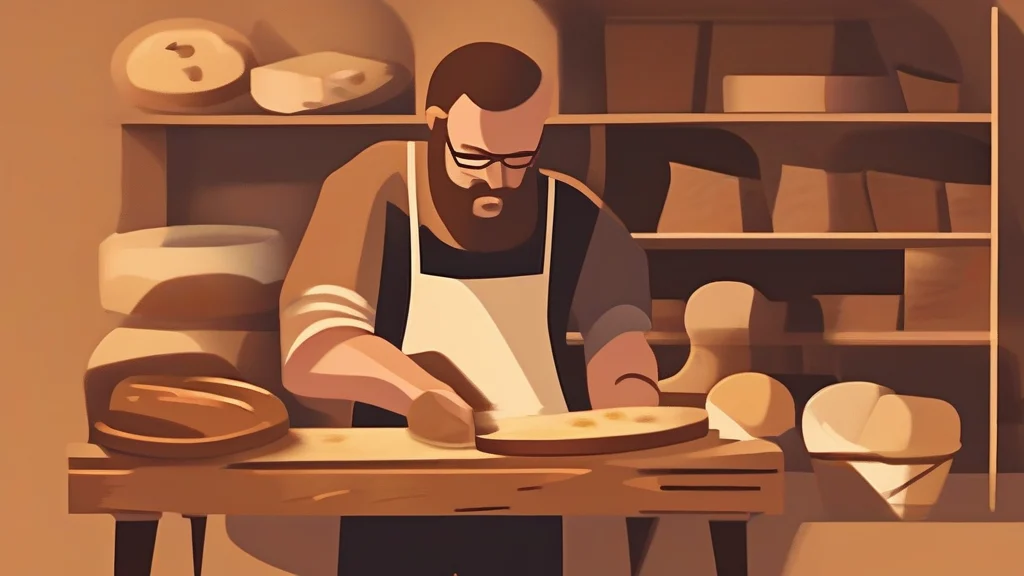
What does artisan mean?
An artisan is a skilled worker who creates things by hand, typically within a specialized craft such as woodworking, baking, cheesemaking, pottery, or textile work. The word emphasizes both technical skill and personal involvement in the making process, distinguishing handmade goods from those turned out by machines in large factories. In everyday modern English, 'artisan' appears frequently in food and retail contexts — artisan bread, artisan chocolate, artisan cheese — where it signals small-batch, traditional, or carefully crafted production. The word carries broadly positive connotations of authenticity, quality, and attention to detail, though its heavy use in advertising means it can sometimes feel more like a branding label than a precise description of how something was actually made. Historically associated with guild trades and workshop apprenticeships, the term remains useful whenever one wants to highlight human skill and care behind a product.
nounA worker in a skilled trade, especially one who makes things by hand, such as furniture, bread, cheese, or textiles. More broadly, a maker of high-quality or distinctive goods produced using traditional methods rather than mass production.
- {'definition': 'A skilled worker who makes things by hand.', 'example': 'Each chair is built by an artisan in a small workshop.'}
- {'definition': 'A person or company producing distinctive, small-batch goods using traditional methods.', 'example': 'She buys her coffee from local artisan roasters.'}
"The bakery is run by an artisan who still shapes every loaf by hand."
"The leather artisan stitched each wallet with careful, even seams."
"This village has been home to artisans weaving silk for over four hundred years."
Standard plural; used when referring to multiple craftsmen or craftswomen collectively.
"The fair brought together dozens of local artisans selling handmade goods."
The word 'artisan' once carried a whiff of manual labor and low social standing — today it's slapped on sourdough loaves and craft beer to signal quality and care.
Reviewed by Deb Chak, Editor. AI-assisted content curated by RJS Tech Solutions LLP.
Etymology of artisan
Artisan entered English in the early 16th century from Italian 'artigiano', meaning a skilled craftsman, which derives from Latin 'ars' (genitive 'artis'), meaning skill or craft. The same Latin root gives English words such as artist, artifice, artifact, and artistry. Originally it simply denoted any manual worker trained in a trade; over time, especially from the late 20th century onward, it acquired connotations of high-quality handcrafted goods.
Related word forms
How artisan is actually used
In modern usage, 'artisan' often carries positive connotations of craftsmanship, authenticity, and small-scale production. It is frequently used as a marketing term on food packaging (artisan bread, artisan cheese) where it may not always reflect genuine hand-production.
Easily confused with artisan
Artisanal is an adjective describing goods made by an artisan, while artisan itself is the noun referring to the person.