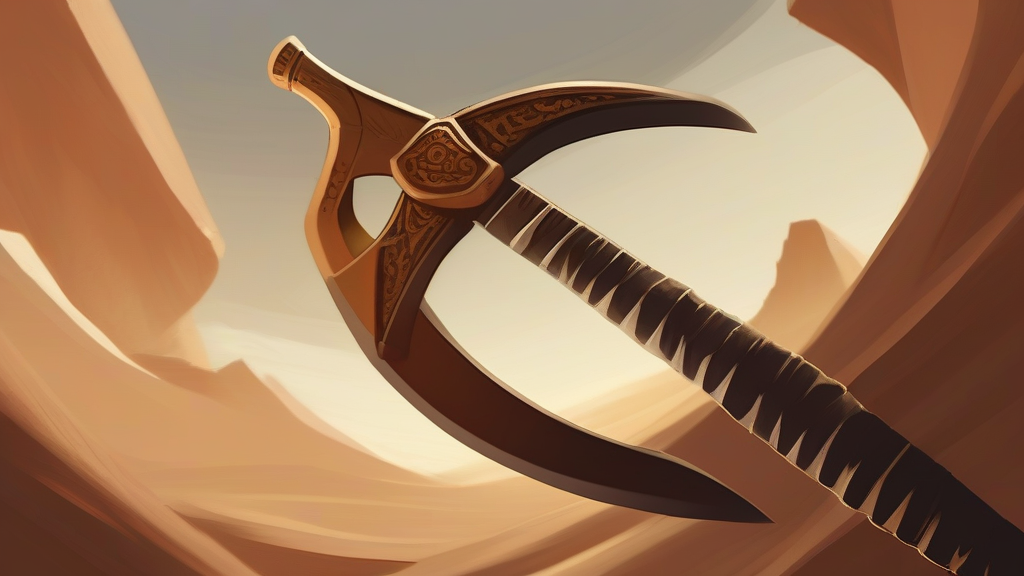
What does ataghan mean?
An ataghan is a long, single-edged sword with a distinctive forward curve, originating in Turkey and used throughout the Ottoman world. Unlike most European sabers, it characteristically lacks a crossguard between blade and hilt, giving it a sleek, unbroken profile. In English, the word is essentially an older variant spelling of yataghan, having entered the language centuries ago — likely through the accounts of European travelers and diplomats describing Ottoman weaponry — before the modern spelling became standard. Today, "ataghan" survives mainly in historical texts, antiquarian descriptions, and literary prose evoking the East, where writers favored it for its exotic resonance. Because the term refers to a specific historical weapon rather than any curved blade, careful writers reserve it for genuine Turkish-style swords, preferring broader words such as scimitar or saber when the exact provenance is unclear. Its rarity gives it a distinctly archaic, bookish flavor.
nounA long, curved Turkish knife or saber without a guard, used as a weapon; a variant form of the word yataghan.
- A long, single-edged, curved Turkish sword or saber lacking a crossguard.
- (Historical) The variant spelling by which this weapon was first introduced into English.
"The sultan's guard carried an ornate ataghan sheathed at his waist."
"He drew the ataghan slowly, its blade catching the lamplight along its gentle curve."
"Museum curators catalogued the ataghan among Ottoman arms collected in the nineteenth century."
Regular plural formation; used when referring to multiple weapons, typically in historical or museum contexts.
"The armory displayed rows of ataghans captured during the campaign."
Before it was ever spelled 'yataghan,' this curved Turkish blade entered English as 'ataghan' — one of those words that wandered into the language through travelers' journals.
Reviewed by Deb Chak, Editor. AI-assisted content curated by RJS Tech Solutions LLP.
Etymology of ataghan
The word derives from the Turkish name for the weapon (yatağan), which was adopted into Western European languages during the early modern period as travelers encountered Ottoman arms. It appeared in English in the seventeenth century in forms including "ataghan," later settling on "yataghan" as the standard spelling. The Turkish root is generally connected to the town of Yatağan in Anatolia, famed for its bladesmiths.
How ataghan is actually used
"Ataghan" is now largely archaic and appears mostly in historical writing and older literature; "yataghan" is the preferred modern spelling. Both are formal, literary terms rather than everyday vocabulary.
Easily confused with ataghan
Yataghan is the standard modern English spelling for this type of Turkish sword, while ataghan is chiefly a historical variant spelling of the same word.