
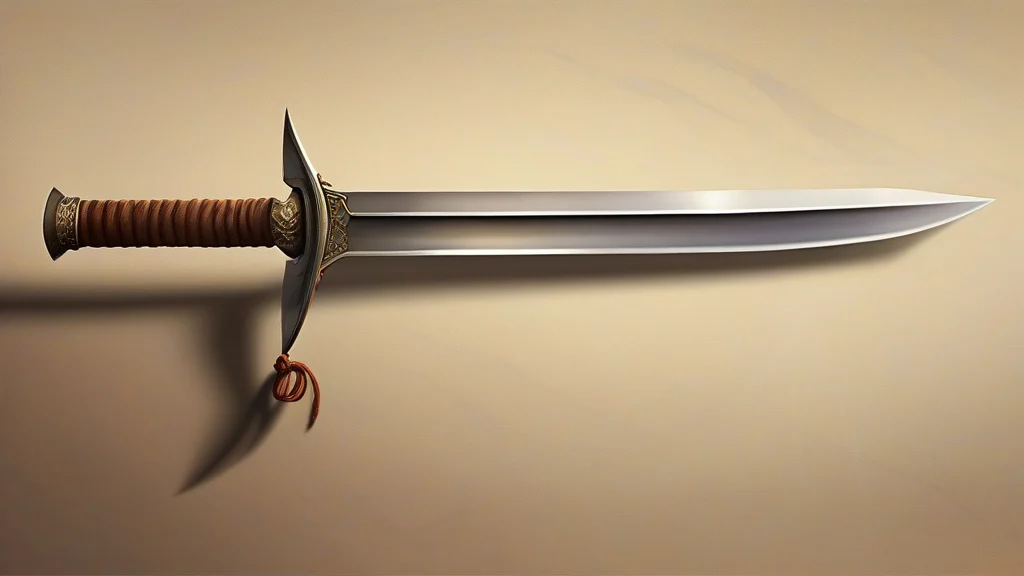
What does cutlass mean?
A cutlass is a short, broad-bladed sword with a single curved cutting edge, best known as the standard sidearm of sailors from roughly the 17th through the 19th centuries. Its compact size, sturdy guard, and heavy blade made it ideal for the chaos of naval combat, where fighters clashed at close quarters on crowded decks and in rigging where longer swords were unwieldy. The word entered English in the late sixteenth or early seventeenth century, borrowed from French coutelas, which itself traces back through Italian coltellaccio, an enlargement of coltello meaning knife. Beyond its military history, the cutlass has taken on a rich cultural life: it is the archetypal pirate weapon in literature and film, appearing everywhere from Treasure Island to countless swashbuckling adventures. Today the term survives chiefly in historical, nautical, and fictional contexts, evoking romance, danger, and the age of fighting sail.
nounA cutlass is a short, broad, slightly curved sword with a single cutting edge, historically used as a naval weapon by sailors and marines.
- A short, broad, curved single-edged sword used historically as a naval sidearm for boarding actions and close combat.
"The boarding party scrambled over the rail with a pistol in one hand and a cutlass in the other."
"The old naval cutlass hung above the fireplace, its brass hilt tarnished green with age."
"In the film, the pirate captain brandished his cutlass and dared anyone to cross him."
The standard plural simply adds -es, following the regular English rule for words ending in -s sounds spelled with a final s.
"The armory contained dozens of rusted cutlasses from decommissioned ships."
The British Navy issued cutlasses to sailors well into the 20th century — making it arguably the last sword officially carried into modern warfare.
Reviewed by Deb Chak, Editor. AI-assisted content curated by RJS Tech Solutions LLP.
Where does cutlass come from?
The English word "cutlass" derives from the French "coutelas", a long knife or short sword, which in turn comes from Italian "coltellaccio", an augmentative form of "coltello" (knife), ultimately rooted in Latin "culter" meaning knife. The borrowing into English dates to the late sixteenth or early seventeenth century, when such weapons were becoming common aboard European warships. Cognates include the French "coutelas" itself and related Romance forms built on the same Latin root.
How cutlass is actually used
"Cutlass" is a concrete historical noun with no figurative or slang extensions of note. It appears most often in historical writing, museum contexts, fiction about pirates or the age of sail, and discussions of edged weaponry. It carries romantic connotations tied to piracy and naval adventure rather than any negative sense. Both American spelling "cutlass" and the same word are standard in British and US usage alike.
Easily confused with cutlass
A saber is typically a longer, lighter cavalry sword designed for thrusting as well as slashing, whereas the cutlass is a shorter, heavier naval weapon.
Despite the similar spelling, a cuttlefish is a marine mollusk unrelated to the cutlass sword; the resemblance is coincidental.