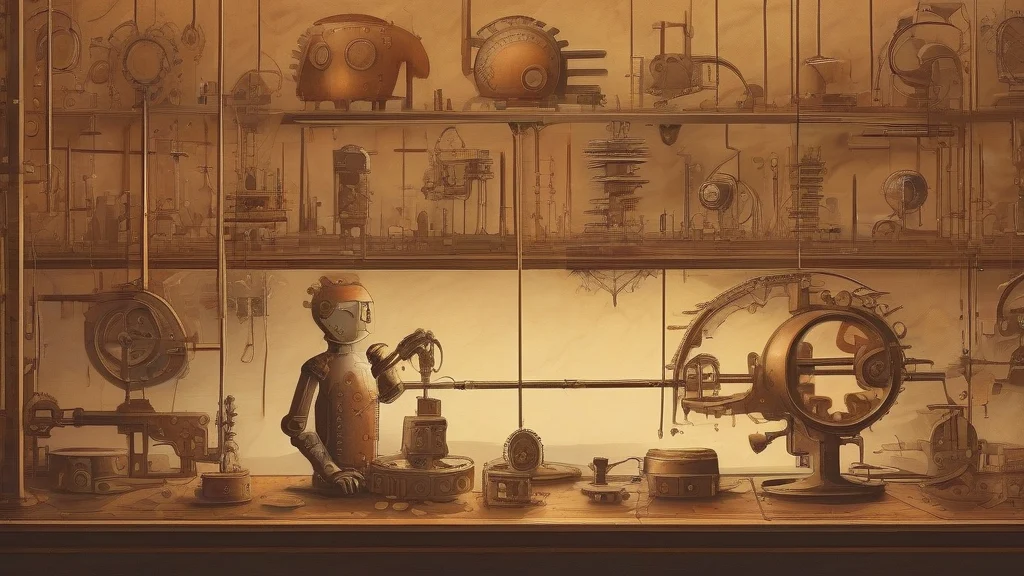
What does automata mean?
Automata is the plural of automaton and refers to self-operating machines — devices designed to move or act on their own, often imitating human or animal behavior. Historically, automata were marvels of craftsmanship: mechanical birds, writers, and dancers built by clockmakers to astonish royal courts. Today the word carries two main lives. In everyday usage it describes any machine that operates automatically, and figuratively it can describe people who act mechanically, without independent thought — a mildly critical connotation. In computer science and mathematics, automata take on a precise technical meaning: abstract machines such as finite automata and cellular automata that model how computations unfold. Derived from Greek roots meaning 'self-acting,' the word lends an air of both antiquity and technological sophistication. Whether describing a museum's mechanical marvels or the foundations of computation theory, automata captures humanity's long fascination with machines that seem alive.
Plural of automaton: self-operating machines or mechanical figures that imitate human or animal actions.
"The exhibition displayed automata from the golden age of mechanical craftsmanship."
Both 'automata' (Greek plural) and 'automatons' (anglicized plural) are correct; 'automata' is preferred in technical and academic contexts.
In computer science, abstract machines used to model computation, such as finite automata or cellular automata.
"Finite automata provide a mathematical foundation for understanding regular languages."
This sense is nearly always used within technical or academic discourse.
'Automata' is itself the standard plural of 'automaton,' derived from Greek. The anglicized plural 'automatons' also exists but is less common in formal usage.
"Victorian fairgrounds were filled with automata that played music and performed tricks."
The word 'automata' is the plural of automaton — and in computer science, entire fields of mathematics are built on 'cellular automata,' simple rules that can generate endlessly complex patterns.
Reviewed by Deb Chak, Editor. AI-assisted content curated by RJS Tech Solutions LLP.
Etymology of automata
Automata comes from the Greek word 'automatos,' meaning 'self-moving' or 'acting of one's own will.' The term entered English via Latin in the early seventeenth century, when mechanical wonders from European workshops made the concept fashionable. It shares its root with other Greek-derived words beginning with 'auto-' meaning 'self,' including automatic, autonomy, and automobile. As the plural of automaton, it preserves the Greek plural form rather than the anglicized 'automatons.'
Related word forms
How automata is actually used
Primarily a formal or technical term. In everyday speech, 'robots' has largely replaced it, but 'automata' remains standard in academic contexts — particularly in theoretical computer science, where phrases like 'finite automata' are fixed terminology. Both 'automata' and 'automatons' are accepted plurals, though 'automata' (the Greek-derived plural) is more common in scholarly writing.
Easily confused with automata
'Automaton' is the singular form referring to one self-operating machine, while 'automata' is its plural.