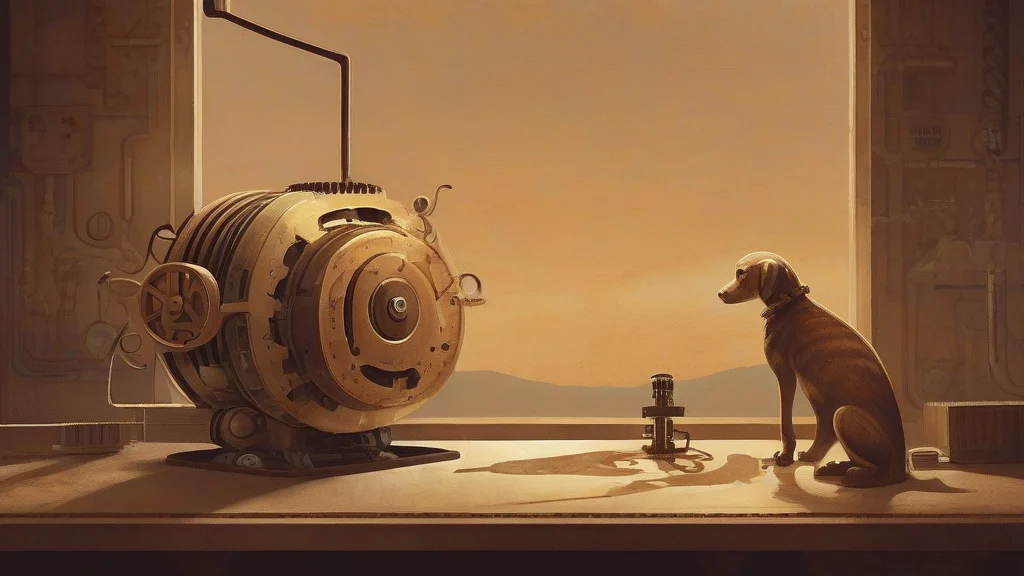
What does automaton mean?
An automaton is a mechanical device — traditionally a moving figure of a person or animal — built to perform actions as if under its own power, from wind-up writing boys and flapping birds to modern robots. The word derives from the Greek 'automatos', meaning acting of one's own will, and entered English in the early seventeenth century. Beyond its literal sense, 'automaton' is widely used figuratively to describe a person who acts mechanically, without thought, feeling, or independence: an office worker who goes through the motions like an automaton has surrendered spontaneity to routine. In computing and mathematics it also names an abstract machine governed by fixed rules, the subject of automata theory. Both plurals are standard — 'automata' in scholarly contexts, 'automatons' elsewhere. The word's connotation depends heavily on context: admiration for ingenious craftsmanship in describing historical devices, but subtle criticism when describing unthinking human behavior.
nounA mechanical figure or device that imitates the actions of a human or animal, often operating automatically. More broadly, a person who behaves in a mechanical, unthinking way, lacking individuality or spontaneity.
- A mechanical device or figure made to move as if by its own power, especially one resembling a person or animal.
- A person who acts mechanically, without thought, emotion, or independent will.
- (Computing) An abstract machine that processes inputs according to fixed rules, as studied in automata theory.
"The museum's eighteenth-century automaton, a mechanical writer that dipped its quill and traced letters across paper, still draws astonished crowds."
"The clockmaker spent years building an automaton of a singing bird that flapped its wings at noon."
"After decades on the assembly line he felt he had become an automaton, performing each motion without a single conscious thought."
Both plurals are correct: 'automata' follows the Greek pattern and dominates academic, scientific, and formal writing, while 'automatons' is fully acceptable in general use.
"The exhibition gathered automata from across Europe, including a mechanical flute player and a writing boy."
In the eighteenth century, a chess-playing automaton called the Turk toured the world defeating Napoleon and Edgar Allan Poe — though secretly a human chess master was hidden inside.
Reviewed by Deb Chak, Editor. AI-assisted content curated by RJS Tech Solutions LLP.
Etymology of automaton
Automaton comes directly from the Greek adjective 'automatos', meaning 'self-moving' or 'acting of one's own accord', formed from 'autos' ('self') plus 'matos' (from 'menos', related to striving or force). The word passed into Latin as 'automatum' and entered English in the early seventeenth century, initially referring to self-operating machines. It shares this Greek root with 'automatic', 'automation', and 'autonomy'. The classical Greek plural 'automata' survives alongside the anglicized 'automatons', with the former favored in technical and academic writing.
Related word forms
How automaton is actually used
The word carries a slightly literary or formal register when applied to people, where it implies criticism — dehumanized, robotic behavior lacking genuine thought or feeling. The plural is disputed: both 'automatons' (anglicized) and 'automata' (classical Greek plural) are accepted, with 'automata' preferred in scientific and academic contexts. In computer science, 'automata theory' is a foundational field, giving the word a technical life entirely apart from its figurative sense.
Easily confused with automaton
An android is specifically a robot designed to resemble a human being, whereas an automaton is any self-operating mechanical device and may take non-human forms such as birds or animals.