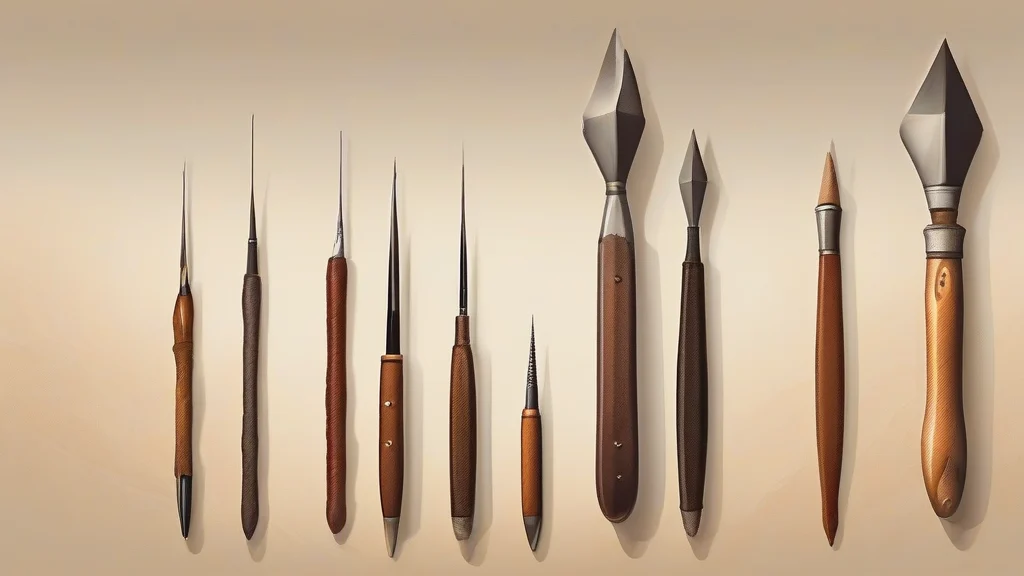
What does awl mean?
An awl is a simple pointed hand tool consisting of a sharp metal spike set into a handle, used to make small holes in leather, wood, fabric, or other materials. Cobblers, saddlers, bookbinders, and carpenters rely on it to pierce material before stitching, lacing, or fastening, often as the first step before inserting a needle or screw. Variants such as the bradawl and stitching awl are adapted to specific trades. Despite its modest size, the awl is among the oldest tools known to archaeology, with examples found at prehistoric sites and even in the belongings of Ötzi the Iceman. The word is pronounced identically to 'all', which can cause momentary confusion in conversation, though their meanings are unrelated. Today 'awl' remains a practical vocabulary item for anyone interested in craft, woodworking, or the history of everyday tools, and it is most often encountered in discussions of leatherwork and shoemaking.
nounA small pointed hand tool with a sharp tip and a handle, used for piercing holes in leather, wood, or other materials.
- A pointed instrument used for piercing small holes in leather, wood, or other materials, especially in shoemaking and leatherwork.
"The cobbler pushed the awl through the stiff leather to start the stitch."
"She used an awl to punch a hole in the belt before setting the buckle."
"The saddler's awl had worn smooth from decades of daily use."
Standard plural; no irregular forms.
"The workshop kept several different awls on the bench."
An awl is so ancient it appears in Ötzi the Iceman's toolkit from over 5,000 years ago — one of humanity's oldest surviving tools.
Reviewed by Deb Chak, Editor. AI-assisted content curated by RJS Tech Solutions LLP.
Etymology of awl
'Awl' descends from Old English 'æwel' and 'æl', meaning a piercing tool or awl, which in turn derives from Proto-Germanic '*awlaz'. It is related to words for piercing tools in other Germanic languages, reflecting the tool's long history across northern Europe. The word has remained remarkably stable in form and meaning since the earliest English records, and its homophone relationship with 'all' is purely coincidental.
How awl is actually used
'Awl' is a concrete, everyday term among craftspeople — cobblers, saddlers, bookbinders — but is less familiar to general speakers. It carries no strong connotations, though it evokes traditional handcraft. The homophone 'all' makes it occasionally misheard in speech.
Easily confused with awl
'All' is a determiner or pronoun meaning the whole of something, while an 'awl' is a pointed piercing tool — they sound identical but differ entirely in spelling and meaning.