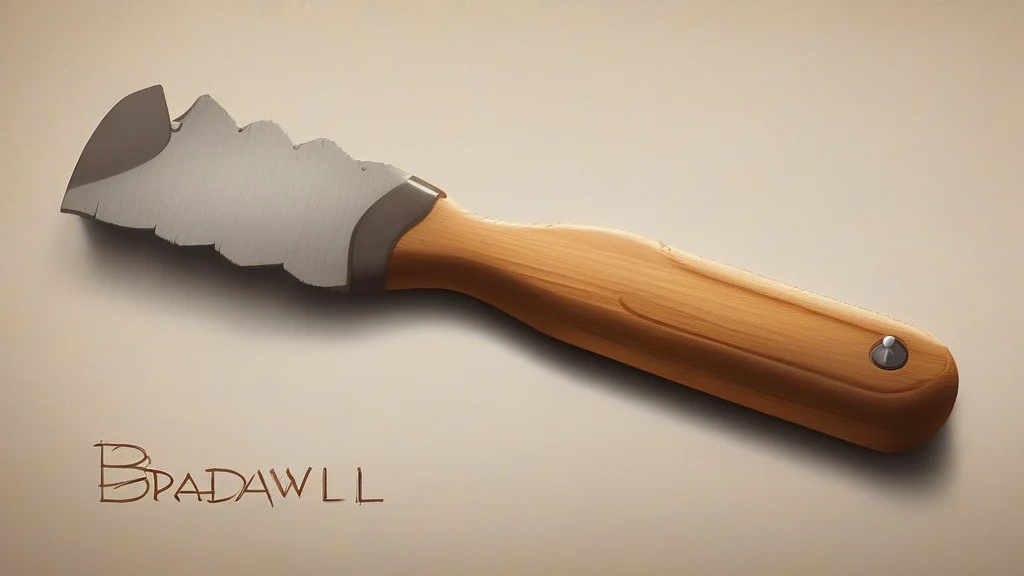
What does bradawl mean?
A bradawl is a small hand tool used chiefly in woodworking to pierce tiny holes or mark precise positions on timber. It consists of a short, straight blade with a sharp, often chisel-shaped tip, mounted in a handle sized for a comfortable grip. Unlike a drill or gimlet, which removes material by boring, a bradawl is pushed or lightly twisted into the wood, splitting the fibers just enough to admit a screw or nail without causing splits. The name combines 'brad', an old word for a slender nail, with 'awl', the general term for a pointed piercing tool. Bradawls are staples of joinery, cabinet-making, and everyday household repair kits, valued for their simplicity and control. The word is primarily British in currency, though understood internationally, and appears almost exclusively in practical, craft-related contexts rather than figurative language.
nounA small woodworking tool consisting of a short, straight blade with a sharp point set in a wooden or plastic handle, used for piercing small holes in wood or marking positions before drilling or screwing.
- A hand tool with a short, pointed, chisel-edged blade on a handle, used to pierce small holes in wood or scribe marks before screwing or nailing.
"He used a bradawl to make a pilot hole before driving in the screw."
"She scored a neat cross with the bradawl where the hinge would sit."
"The carpenter reached for his bradawl rather than the drill, needing only a shallow starter hole."
Standard regular plural; used when referring to multiple such tools, e.g. in a toolkit or workshop inventory.
"The workshop bench held an assortment of bradawls in varying sizes."
The humble bradawl hasn't changed much in centuries — its name literally fuses two ancient tools, the 'brad' (a thin nail) and the 'awl' (a piercing spike).
Reviewed by Deb Chak, Editor. AI-assisted content curated by RJS Tech Solutions LLP.
Etymology of bradawl
The word bradawl is formed by compounding two older English terms: 'brad', meaning a thin, headless nail (from Middle English, ultimately related to Old English 'bræd', a spike or goad), and 'awl', a pointed piercing tool descended from Old English 'æl'. The compound emerged in the early modern period, by around the seventeenth century, as carpenters distinguished this flat-bladed variant from other awls. Its closest relatives are therefore the component words themselves — the awl family of piercing tools and the brad family of small nails — rather than borrowings from other languages.
How bradawl is actually used
Primarily a workshop and DIY term, more frequently encountered in British English than American English. It carries no figurative or extended senses and remains strictly literal in usage.
Easily confused with bradawl
An awl is any pointed piercing tool (often with a rounded or tapered blade), while a bradawl specifically has a flat, chisel-like blade designed to cut a narrow slit in wood.
A gimlet has a screw-like twisted tip that bores by rotating and removes material, whereas a bradawl simply pierces or splits the wood fibers with a straight push.
A brad is a thin nail without a significant head; the bradawl is the tool whose name derives partly from 'brad', but it refers to the instrument, not the fastener.