What does babouche mean?
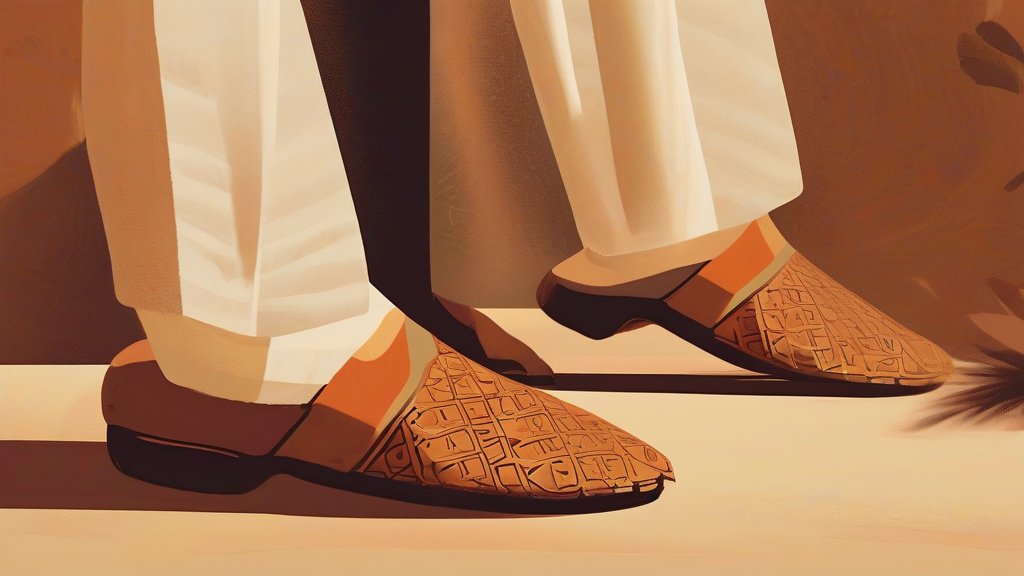
A babouche is a soft, heelless slipper made of leather, traditionally worn throughout North Africa and the Middle East. Typically featuring a pointed or gently upturned toe and no backing around the heel, it is designed to be slipped on and off effortlessly — a practical quality that suits cultures where footwear is removed indoors. In Morocco, Algeria, Tunisia, and Turkey, babouches have been everyday footwear for centuries, made by artisans in colors ranging from plain natural leather to vivid yellows and embroidered golds. In English, the word surfaces chiefly in travel writing and fashion coverage, where 'babouche' also names a flat, backless slipper silhouette adapted by contemporary designers. Its exotic associations give it a distinctly evocative flavor: to mention babouches is to conjure souks, riads, and mosaic courtyards. The plural, 'babouches', is standard in all contexts.
nounA heelless slipper of soft leather, traditionally worn in North African and Middle Eastern countries, typically with pointed or upturned toes.
- A heelless leather slipper worn in North Africa and the Middle East, often with a pointed or slightly turned-up toe.
"She slipped off her sandals at the riad door and stepped into a pair of embroidered yellow babouches."
"The artisan stitched each pair of babouches by hand in his tiny Fez workshop."
"Guests left their shoes on the terrace and padded around the villa in borrowed babouches."
The plural 'babouches' follows regular English -s formation and is used freely, even when referring to a single pair.
"Rows of colorful babouches hung from the shopfront, waiting for customers."
In Morocco, slipping off your babouches at the door isn't bad manners — the heelless slipper was designed to be kicked off in one motion.
Reviewed by Deb Chak, Editor. AI-assisted content curated by RJS Tech Solutions LLP.
Etymology of babouche
English borrowed 'babouche' in the early 19th century from French, which took it from Arabic 'bābūsh', meaning slipper. The Arabic term itself likely traces back through Persian 'pāpūsh', a compound of 'pā' (foot) and 'pūsh' (that which covers), reflecting the long cultural exchange between Persian, Arab, and Ottoman worlds. Cognate forms such as Turkish 'pabuç' preserve the same lineage.
How babouche is actually used
Babouche appears most often in travel writing, fashion journalism, and descriptions of North African culture; it is occasionally used loosely for flat backless slipper styles sold in Western boutiques under that name.
Easily confused with babouche
A barouche is a four-wheeled horse-drawn carriage popular in the 19th century, whereas a babouche is a soft leather slipper; the two words merely sound alike.
'Babu' refers to an educated Indian clerk or gentleman (or, pejoratively, affected Anglo-Indian style), while 'babouche' names a type of slipper.