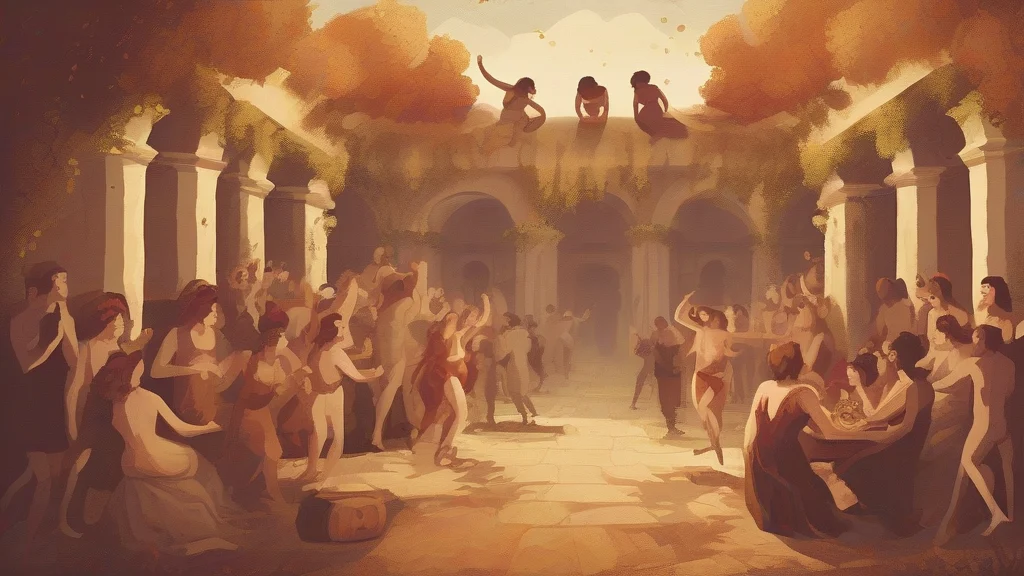
What does bacchanalia mean?
Bacchanalia denotes a scene of wild, drunken revelry — an occasion of uninhibited feasting, drinking, and merriment. The word descends from the ancient Roman festivals of Bacchus, the god of wine, whose ecstatic rites grew so notorious that the Roman Senate formally suppressed them in 186 BC. In modern English, 'bacchanalia' has shed its strictly religious meaning and is applied figuratively to any exuberant, over-the-top celebration, whether a raucous party, a hedonistic holiday crowd, or a frenzied night on the town. The term always appears in its plural form, yet it commonly functions as a singular noun describing one episode of abandon ('the awards ceremony turned into a bacchanalia'). Its connotations lean toward excess and loss of self-control; writers use it either to condemn debauchery or to lend colourful, mock-grandiloquent flair to descriptions of high-spirited festivities.
nounA scene or period of drunken revelry and unrestrained merrymaking; originally, the secret festivals held in ancient Rome in honour of the wine god Bacchus.
- A bout of drunken, uninhibited revelry or celebration.
- (historical) The ancient Roman festival in honour of Bacchus, god of wine, celebrated with ecstatic rites and eventually suppressed by decree of the Senate in 186 BC.
"The conference ended not in quiet farewells but in a full-blown bacchanalia that lasted until dawn."
"What had begun as an elegant dinner party dissolved by midnight into sheer bacchanalia."
"The Senate moved to suppress the Bacchanalia in 186 BC, alarmed by reports of the rites' excesses."
'Bacchanalia' exists almost exclusively in its plural form; a further plural 'bacchanalias' is rare and generally avoided. In modern usage the plural-form noun often behaves as a singular when naming one event.
"Each spring break brings its own bacchanalia to the beach towns."
Rome banned the Bacchanalia outright in 186 BC after they grew so riotous that the Senate arrested thousands of worshippers — making this one of history's first outlawed parties.
Reviewed by Deb Chak, Editor. AI-assisted content curated by RJS Tech Solutions LLP.
Etymology of bacchanalia
Bacchanalia comes from Latin, where Bacchanalia was the name of the festivals honouring Bacchus, the Roman god of wine — himself adapted from the Greek Dionysus. The Latin derives from Bacchus, ultimately tracing back to Greek Bakchos. English adopted the word in the late sixteenth century, at first referring to the historical Roman rites, and by extension it came to mean any wild revelry. Cognate English forms include 'bacchanal', 'bacchic', and the adjective 'bacchanalian', all built on the same root.
Related word forms
How bacchanalia is actually used
Always plural in form, 'bacchanalia' is typically treated as a singular mass noun when describing a single episode of revelry ('an all-night bacchanalia'), though classical usage treats it as a true plural. It carries connotations of excess and abandon — often disapproving in tone, though sometimes used with affectionate exaggeration for any lively celebration.
Easily confused with bacchanalia
A 'bacchanal' is a participant in, or a single episode of, wild revelry (and can be an adjective), while 'bacchanalia' refers to the revelrous event or festival itself and is used as a plural noun.