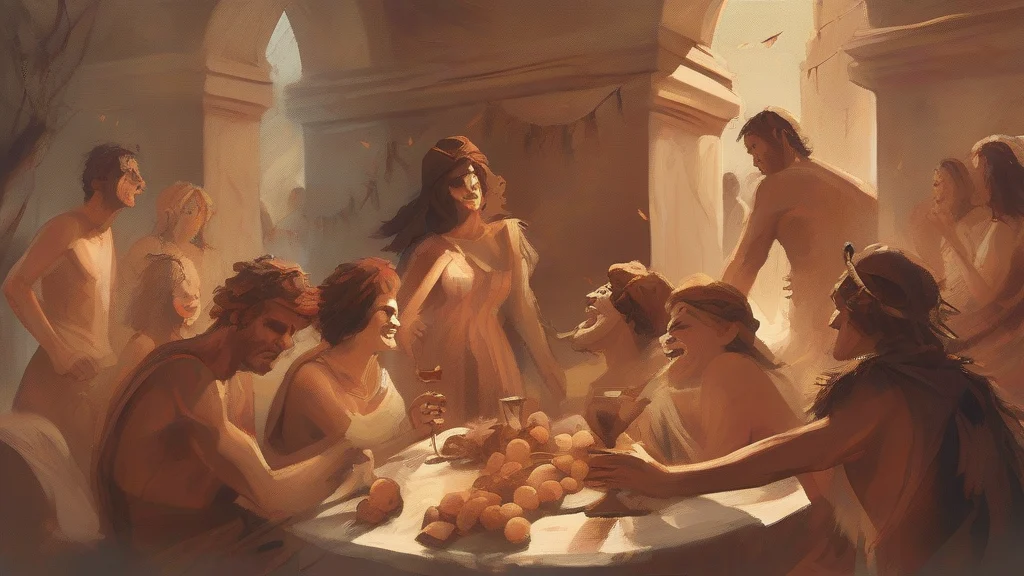
What does bacchanalian mean?
Bacchanalian describes scenes of riotous, drunken celebration — festivities so exuberant and unrestrained that they evoke the wild rites of Bacchus, the Roman god of wine. An adjective used chiefly in literary, journalistic, and critical writing, it paints a vivid picture of feasting, drinking, dancing, and general abandon, whether affectionately (as in accounts of a legendary party) or disapprovingly (as in condemnations of decadence and excess). The word derives from Bacchus, whose festivals, the Bacchanalia, spread through Rome before being restricted by decree in 186 BC after reports of scandalous behavior. Today it appears in phrases such as 'bacchanalian revelry' or 'a bacchanalian feast,' lending an air of classical erudition to descriptions of hedonism. Its connotations are ambivalent: it can celebrate joyful abandon or signal moral looseness, depending on context, which makes it a versatile word for writers describing both glorious parties and disgraceful overindulgence.
Of, relating to, or characterized by drunken revelry or riotous festivity, especially as associated with the worship of Bacchus.
"The novelist depicted the emperor's court as a bacchanalian world of endless banquets and excess."
Most commonly used attributively or predicatively in descriptive and journalistic prose.
A person who engages in or is given to drunken revelry.
"He was known among his friends as an unrepentant bacchanalian who never refused a toast."
This noun sense is rare compared with the adjective.
Applies only to the rare noun sense meaning a person given to revelry.
"The tavern was crowded with bacchanalians celebrating well past midnight."
Named after Bacchus, the Roman god of wine, whose festivals were once banned by the Roman Senate for getting so out of hand that they were deemed a threat to public order.
Reviewed by Deb Chak, Editor. AI-assisted content curated by RJS Tech Solutions LLP.
Etymology of bacchanalian
Bacchanalian derives from the Latin Bacchus, god of wine, adopted from the Greek Dionysus, whose ecstatic worship inspired the festival known as the Bacchanalia. The adjective entered English usage in the early modern period, drawing on Latin roots to describe revelry reminiscent of those rites. Cognate forms include the noun bacchanal and the agentive bacchant, referring to a participant in the festivities.
Related word forms
How bacchanalian is actually used
Bacchanalian is a literary and somewhat elevated term, common in journalism, criticism, and descriptive prose. It carries connotations of pleasurable but excessive indulgence rather than moral condemnation, though it can imply disapproval when used critically.
Easily confused with bacchanalian
Bacchanalia refers specifically to the ancient Roman festivals of Bacchus (or their modern revivals as events), while bacchanalian describes anything resembling the drunken revelry associated with them.