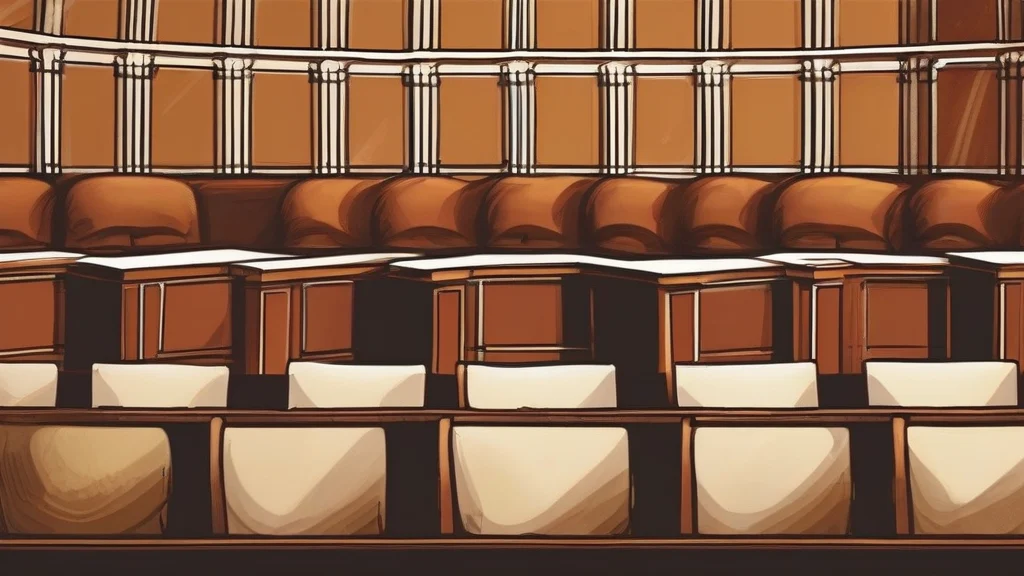
What does backbench mean?
Backbench denotes the rear rows of seats in a legislative chamber—especially the UK House of Commons—occupied by members who hold no position in government or in the official opposition leadership. By extension, it refers collectively to those rank-and-file members themselves. Because seating in many parliaments mirrors seniority, the backbench carries connotations of relative inexperience or lack of power: newly elected MPs typically begin there, and demoted ministers are said to 'return to the backbench'. Yet the term is not merely descriptive; backbenchers can wield real influence through votes, parliamentary committees, and organized dissent, and a 'backbench rebellion' is a recognized threat to any government's authority. The individual member is called a backbencher. Though most strongly associated with British politics, comparable usage exists across Commonwealth parliaments, while American commentary more often speaks simply of rank-and-file members.
nounThe benches in a legislative chamber occupied by members who do not hold official office in government or opposition leadership; by extension, the rank-and-file backbenchers themselves viewed collectively. The term is used chiefly of the UK House of Commons and similar parliaments.
- The rear rows of seats in a parliament reserved for members who hold no ministerial or shadow-office position.
- The collective body of such non-office-holding members, often discussed as a political force (e.g., 'the backbench').
"As a new MP, she spent her first year on the backbench learning how Parliament really works."
"After the cabinet reshuffle, the former minister returned to the backbench."
"A backbench rebellion forced the government to soften its stance on the bill."
When referring to the seats themselves, 'backbenches' is standard; when referring to the members, 'backbench' often functions as a collective singular.
"Dissatisfaction rippled through the backbenches during the debate."
In Westminster's two-tier seating, where you sit literally signals how much power you have — the 'backbench' is where MPs wait their turn to matter.
Reviewed by Deb Chak, Editor. AI-assisted content curated by RJS Tech Solutions LLP.
Etymology of backbench
The word is a straightforward compound of 'back' and 'bench', coined in reference to the physical layout of the House of Commons, where junior members without ministerial or shadow-office roles sit on the rear benches behind the prominent front benches occupied by ministers and shadow ministers. It emerged as part of British parliamentary vocabulary alongside its counterpart 'frontbench', with both terms becoming established in political journalism in the 20th century. The derived form 'backbencher' for an individual member followed naturally from the same seating metaphor.
Related word forms
How backbench is actually used
Chiefly British and Commonwealth political vocabulary; less common in US usage, where 'rank-and-file members' is more typical. Often used attributively before another noun ('backbench dissent', 'a backbench revolt'). The related noun 'backbencher' refers to an individual member.
Easily confused with backbench
Frontbench refers to the seats and members holding senior government or shadow positions, while backbench refers to ordinary members without such office.