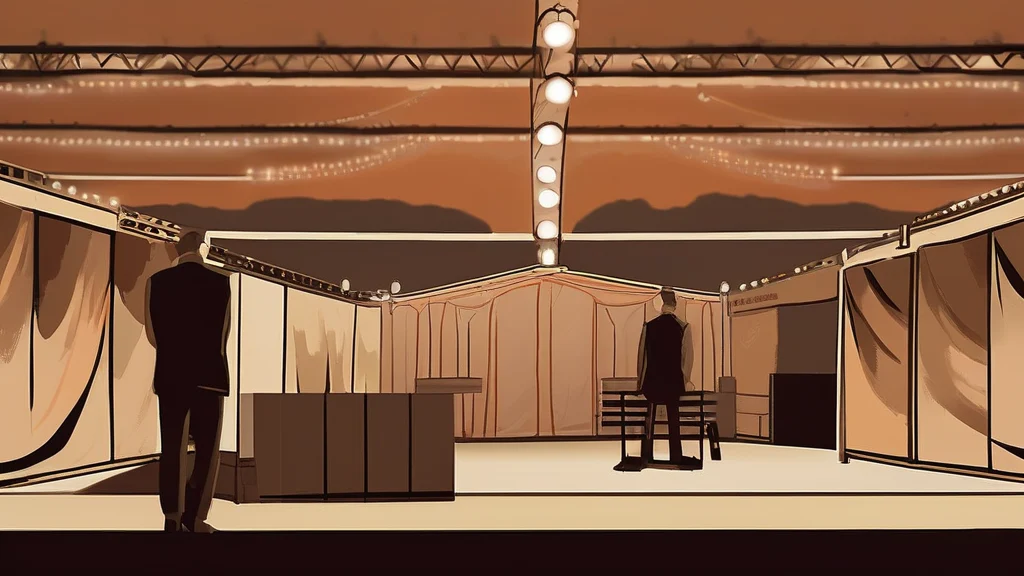
What does backstage mean?
Backstage is the area of a theatre or performance venue lying behind the stage — the dressing rooms, wings, and technical spaces where performers and crew prepare and work out of the audience's sight. By extension, the term is applied to any hidden zone of activity, whether at a concert hall, a television studio, or a political event: the unseen labor and negotiation that make a public performance possible. Backstage can serve as a noun ('the actors were backstage'), an adjective ('a backstage pass', which grants privileged access), or an adverb ('she went backstage'). Because it is associated with restricted access and glimpses of how things really work, the word carries connotations of exclusivity and intrigue. Sociologist Erving Goffman famously used the frontstage/backstage distinction to describe how people manage their public personas versus their private selves.
The area behind the stage of a theatre or performance venue, containing dressing rooms, wings, and technical spaces, where performers and crew work away from public view.
"The director called the cast backstage for a final note before the second act."
Often used with the sense of restricted access; a 'backstage pass' grants entry to this area.
Relating to, situated in, or characteristic of the behind-the-scenes areas of a venue or the private workings of an organization.
"He used his backstage connections to secure tickets."
Frequently attributive, as in 'backstage crew' or 'backstage tour'.
In or toward the area behind the stage.
"The understudy was told to wait backstage until her cue."
Rarely pluralized; backstage is almost always treated as an uncountable mass noun referring to a general zone rather than countable individual areas.
"The documentary compared the backstages of three different opera houses."
Every star you've ever applauded walked through the same unglamorous corridors first — backstage is where the magic is actually made.
Reviewed by Deb Chak, Editor. AI-assisted content curated by RJS Tech Solutions LLP.
Etymology of backstage
Backstage is formed simply from the English words 'back' and 'stage'. The noun 'stage' itself derives via Old French 'estage' from Latin 'staticum', meaning a standing place, ultimately from the verb 'stare' (to stand). As theatres developed elaborate wing and scenery systems from the seventeenth century onward, the space behind the visible playing area became a distinct zone, and the compound backstage arose to name it. Its extended figurative use for any behind-the-scenes area grew naturally out of its theatrical origin.
How backstage is actually used
Backstage functions as a noun, an adverb ('go backstage'), and an adjective ('a backstage pass'). It carries connotations of exclusivity and privileged access — a 'backstage pass' is a coveted item. The word is standard in both British and American English with no significant regional variation.
Easily confused with backstage
A backstay is a nautical rigging line supporting a mast, whereas backstage refers to the area behind a theatre stage.
Backside means the rear part of something (or, informally, a person's buttocks), while backstage specifically denotes the behind-the-scenes area of a venue.