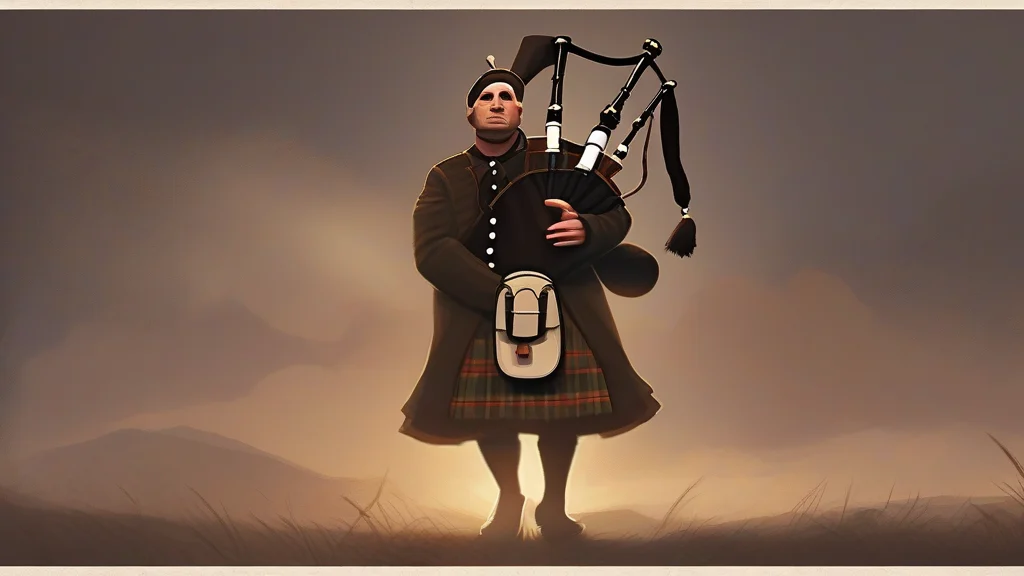
What does bagpiper mean?
A bagpiper is a musician who plays the bagpipes, most commonly the Great Highland Bagpipe associated with Scotland. The term denotes the performer rather than the instrument, distinguishing it from related words such as piper, which can refer to players of any pipe-like wind instrument. Bagpipers hold a prominent place in Scottish and Irish cultural life, appearing at weddings, funerals, military ceremonies, parades, and Highland games, where their loud, penetrating sound makes them ideal for outdoor performance. Historically, bagpipers served functional roles in battle, using music to rally troops and mark marches. Today the word carries connotations of tradition, ceremony, and national heritage. While anyone who plays any form of bagpipe may properly be called a bagpiper, the image most people associate with the term is the tartan-clad Highland player performing a lament or march.
nounA bagpiper is a person who plays the bagpipes, especially the Great Highland Bagpipe of Scotland.
- A musician who plays the bagpipes, particularly the Great Highland Bagpipe.
"The lone bagpiper played a lament at the foot of the castle wall."
"A bagpiper led the funeral procession through the village square."
"Street performers and wedding entertainers alike hire a skilled bagpiper to set a stirring Scottish tone."
Standard plural formation with -s; used when referring to multiple performers.
"Three bagpipers opened the ceremony with a traditional march."
A single bagpiper can be heard from over a mile away — which is exactly why armies once used them to lead troops into battle.
Reviewed by Deb Chak, Editor. AI-assisted content curated by RJS Tech Solutions LLP.
Etymology of bagpiper
The word bagpiper combines 'bagpipe' — from the Middle English 'bagge' plus 'pipe,' ultimately deriving from Old English 'pipa,' borrowed from Vulgar Latin or medieval Latin forms related to the Latin 'pipare' (to chirp or peep) — with the agentive suffix '-er,' denoting one who performs an action. The instrument itself has ancient roots across Europe and the Middle East, but the English compound for its player developed alongside the instrument's spread through Britain during the medieval period. Cognate terms such as simply 'piper' appear throughout Middle English literature, including in Chaucer.
How bagpiper is actually used
The word is neutral in register but strongly associated with Scottish cultural tradition; 'bagpiper' is somewhat more specific than the broader term 'piper.'
Easily confused with bagpiper
A piper plays any kind of pipe instrument, whereas a bagpiper specifically plays the bagpipes, a wind supply-driven reed instrument with an air bag.
Bagpipes refers to the musical instrument itself, while a bagpiper is the person who plays that instrument.