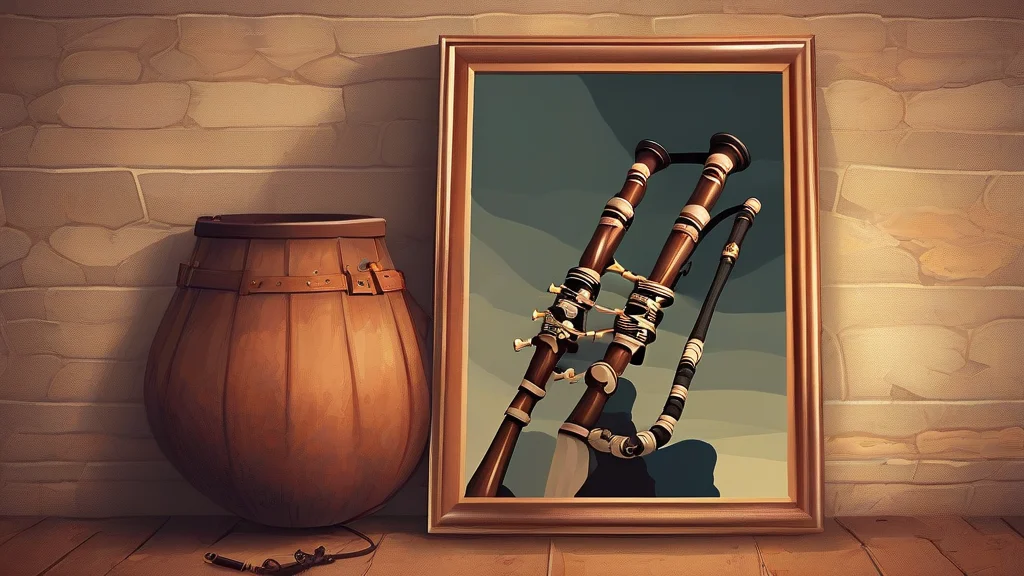
What does bagpipe mean?
A bagpipe is a wind instrument that produces sound by forcing air from a leather or synthetic bag, kept inflated by the player's breath (or bellows), into one or more reed pipes. The player sustains a melody on a fingered pipe called the chanter, while typically one or more drones provide a continuous harmonic background — a hallmark of the instrument's distinctive, unbroken sound. Although most closely identified with Scottish Highland tradition, where the Great Highland Bagpipe is central to military, ceremonial, and folk music, bagpipes of many designs have existed for centuries across Europe, North Africa, and western Asia. The word is used neutrally in both British and American English, with the plural "bagpipes" often serving as the everyday name for the instrument. Its evocative, penetrating tone makes it a fixture at funerals, weddings, parades, and festivals worldwide.
nounA wind instrument consisting of one or more pipes sounded by reeds, with air supplied from a bag inflated by the player, most famously associated with Scottish Highland music.
- A musical wind instrument in which air forced from a bag through reed pipes produces a continuous sound, especially the Great Highland Bagpipe of Scotland.
- (in plural or generic use) Any of a family of related instruments found across Europe, North Africa, and western Asia.
"The lone bagpiper played a haunting lament at the close of the ceremony."
"At dawn on the ridge, a solitary piper played the regimental march on his bagpipe."
"Medieval manuscripts show shepherds entertaining crowds with an early form of the bagpipe."
The plural refers either to multiple instruments or, commonly, to the instrument type as a whole.
"The band tuned their bagpipes before leading the parade."
The Romans marched to war behind them, and centuries later the British Army banned them from battle — because they made enemies fight harder.
Reviewed by Deb Chak, Editor. AI-assisted content curated by RJS Tech Solutions LLP.
Etymology of bagpipe
The word "bagpipe" comes from Middle English, formed transparently from "bag" plus "pipe," reflecting the instrument's two defining components. It was well established by the late medieval period; Chaucer mentions the instrument in the fourteenth century. The underlying word "pipe" traces back through Old English "pīpe" to Latin "pipare," meaning to peep or chirp, which also gives English related musical words such as "fife" and "flageolet." Cognate terms for bagpipe-like instruments appear across European languages, reflecting the instrument's long, widespread history.
Related word forms
How bagpipe is actually used
"Bagpipe" is neutral in register. In everyday speech, especially in Britain, people more often say "the bagpipes" when referring to the instrument generically. The word carries strong cultural associations with Scotland, though similar instruments exist across many cultures.
Easily confused with bagpipe
"Bagpipes" is simply the plural form of "bagpipe," though it is often used as the standard way to refer to the instrument as a whole.