
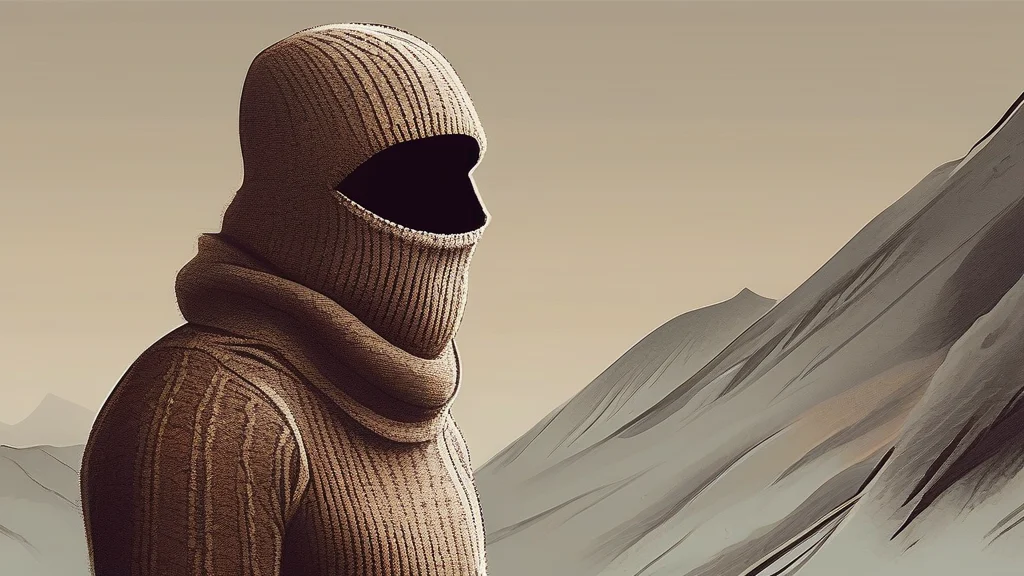
What does balaclava mean?
A balaclava is a close-fitting knitted garment that covers the entire head and neck, leaving open only the eyes and often the mouth. Worn primarily for protection against severe cold, it is popular among skiers, cyclists, motorcyclists, hikers, and outdoor workers, and is also used by military and police personnel. The word takes its name from Balaclava, a town in Crimea associated with the Crimean War of the 1850s, when British troops endured harsh winters there. In everyday speech the item is also widely known as a ski mask, especially in North America. Because it hides the wearer's face, the balaclava has a dual cultural character: it is an unremarkable piece of cold-weather kit outdoors, yet indoors or in urban settings it can signal concealment or menace. Its blend of practical warmth and anonymity makes it one of the most recognizable and occasionally controversial garments in modern dress.
nounA close-fitting knitted garment covering the head, neck, and much of the face, with openings only for the eyes (and often the mouth). It is worn chiefly for warmth in cold weather, and sometimes to conceal identity.
- A close-fitting knitted covering for the head, neck, and face with openings for the eyes (and often mouth), worn for warmth or concealment.
"She pulled on her balaclava before stepping out into the freezing wind."
"Cyclists in Chicago wear a balaclava under their helmets through the coldest months."
"The bank robber's face was entirely hidden by his balaclava."
Standard pluralization; some style guides may treat it as a plural-only garment name informally, but 'balaclavas' is standard.
"The team packed several spare balaclavas for the expedition."
The balaclava is named after a town in Crimea where British troops suffered through a brutally cold winter during the Crimean War — the garment they sent home for became a global winter staple.
Reviewed by Deb Chak, Editor. AI-assisted content curated by RJS Tech Solutions LLP.
Etymology of balaclava
The word derives its name directly from Balaclava (also spelled Balaklava), a town on the Crimean Peninsula in present-day Ukraine. British troops stationed there during the Crimean War (1853–1856) suffered severely in the winter cold, and head coverings of this kind came to be associated with them and named after the battle and port. The place name itself ultimately traces back through Turkish origins, but the garment's English name dates to the mid-19th century following the war's notoriety in Britain.
How balaclava is actually used
Commonly called a 'ski mask' in North America, though 'balaclava' is increasingly used there as well. In British English it is the standard term. Because it conceals the face, wearing one indoors or in public can carry connotations of criminality or intimidation in some contexts, while in others (winter sports, motorcycling, military use) it is entirely practical.
Easily confused with balaclava
Baklava is a rich sweet pastry made of filo dough, nuts, and honey; a balaclava is a head-and-face covering garment.