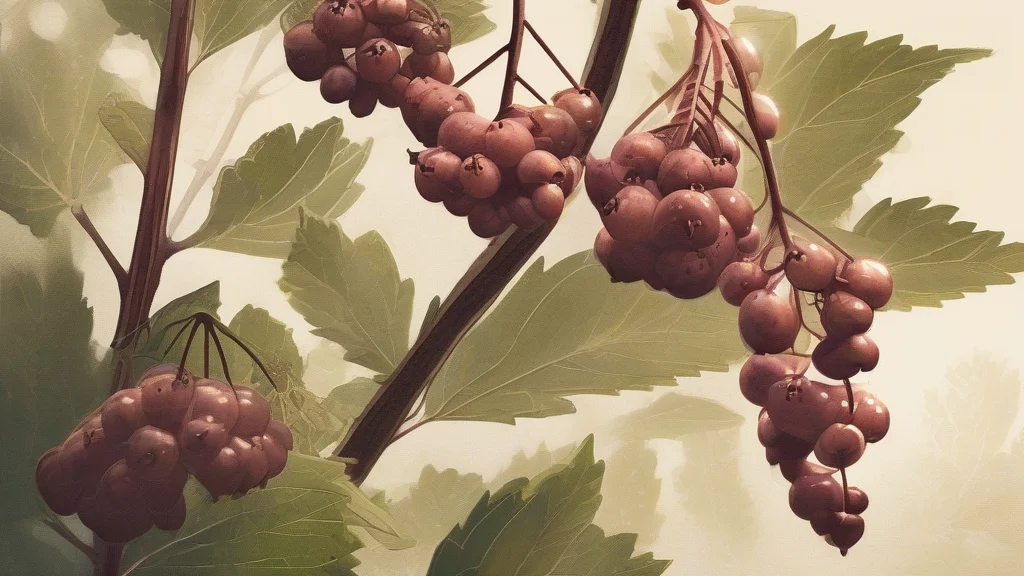
What does baneberry mean?
Baneberry refers to the fruit — and by extension the plant — of several species in the genus Actaea, woodland perennials native to north temperate regions including much of North America, Europe, and Asia. The name signals its most important quality: the berries are poisonous, as are other parts of the plant, particularly the roots. The white baneberry (Actaea pachypoda), known colloquially as doll's-eyes for its eerie porcelain-white berries tipped with a single dark spot, is among the most recognizable, while the red baneberry (Actaea rubra) bears glossy scarlet fruit. Despite their toxicity, baneberries are valued ornamentally in shade gardens for their delicate white flower clusters in spring and their striking berries in late summer. The word is chiefly used in botanical, horticultural, and outdoor-safety contexts, serving as a cautionary term that helps foragers and parents alike identify which woodland fruits must never be eaten.
nounA berry of any of several plants of the genus Actaea (formerly classed in some classifications as Cimicifuga), especially the white baneberry or red baneberry; the plants themselves are herbaceous perennials of north temperate regions whose berries are highly poisonous.
- The poisonous berry of a plant of the genus Actaea, such as the white or red baneberry.
- The plant itself, an herbaceous perennial of north temperate woodlands bearing these berries.
"She warned the children not to touch the white baneberry growing along the shaded trail."
"Hikers should learn to recognize baneberry before snacking on wild berries in the forest."
"The garden's shady corner was brightened by the striking red baneberry in late summer."
Standard pluralization; used both for multiple individual berries and collectively for plants of the genus.
"Clusters of baneberries stood out vividly against the dark forest floor."
Its most famous form is nicknamed 'doll's eyes' — porcelain-white berries with a single black dot that look like toy eyeballs and can kill you.
Reviewed by Deb Chak, Editor. AI-assisted content curated by RJS Tech Solutions LLP.
Etymology of baneberry
The word baneberry is formed from the compound of 'bane', an Old English word (bana) meaning a killer or cause of death, and 'berry', reflecting the plant's deadly fruit. The name arose in English as a folk designation warning of the plant's toxicity, long before formal botanical classification placed it in the genus Actaea. It shares its root with other 'bane' compounds such as ratsbane and wolfsbane, all named for things they destroy.
How baneberry is actually used
Baneberry is a somewhat technical or botanical term, encountered mostly in field guides, gardening literature, and discussions of wild plants rather than everyday conversation. It carries an inherent connotation of danger because all parts of the plant, especially the berries and roots, are toxic if eaten. The two best-known North American species are Actaea pachypoda (white baneberry, called doll's-eyes) and Actaea rubra (red baneberry).
Easily confused with baneberry
Bayberry is a wax-myrtle shrub with aromatic berries used for candles, whereas baneberry is a poisonous woodland plant of the genus Actaea.