What does banneret mean?
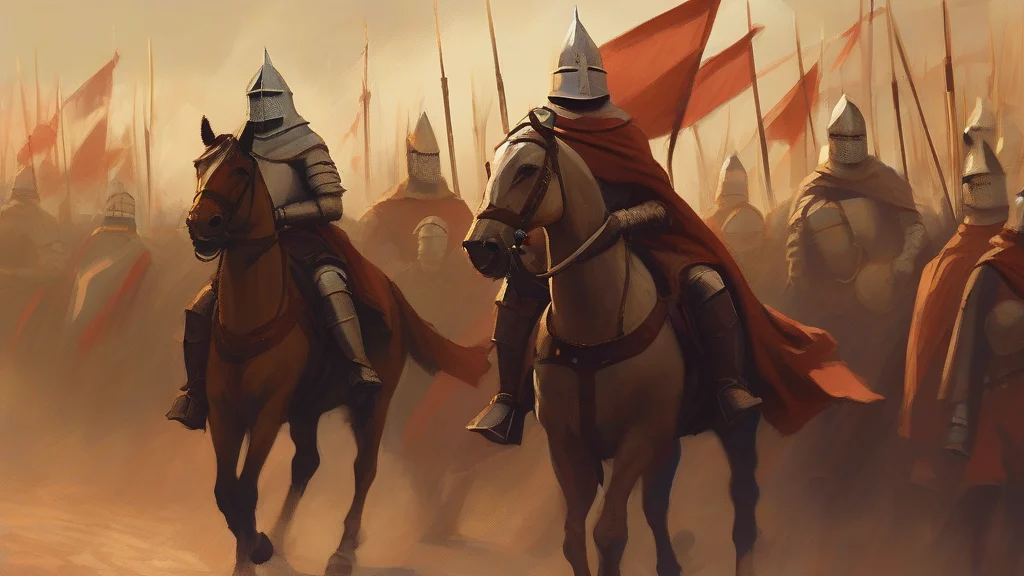
Banneret refers to a rank of medieval knighthood granted to a knight of sufficient wealth and standing to raise and command a body of troops under his own square banner, placing him above the ordinary knight bachelor in the feudal hierarchy. In England, the title came to be conferred by the monarch as an honor for exceptional valor in battle, typically by cutting off the pointed tail of the knight's pennon to make it square. The word derives from Old French, rooted in 'ban' or 'banner,' meaning a standard or call to arms. Today banneret survives almost exclusively in historical, heraldic, and literary contexts, where it evokes chivalry, battlefield distinction, and the pageantry of the Middle Ages. It should not be confused with baronet, a much later hereditary honor established in 1611.
nounA medieval knight who was wealthy or distinguished enough to lead troops of his own under a square banner, ranking above an ordinary knight bachelor; later, an honorary title conferred by the English monarch on the battlefield.
- A medieval knight commanding vassals under his own square banner, superior to a knight bachelor.
- An honorary knighthood conferred by the sovereign for valor in battle (historically, chiefly in England).
"For his valor at Crécy, the young knight was elevated to the rank of banneret."
"The king raised him to the dignity of banneret after he rallied the flank at Agincourt."
"In feudal musters, a banneret's contingent was listed separately from those of mere knights bachelor."
Standard pluralization applies.
"The roll of honor recorded the names of twelve bannerets who fought that day."
A banneret could be made only on the field of battle — you literally had to earn the right to fly your own square flag.
Reviewed by Deb Chak, Editor. AI-assisted content curated by RJS Tech Solutions LLP.
Etymology of banneret
Banneret comes from Old French, derived from 'ban,' a term denoting a proclamation or summons to arms, and closely related to 'banner,' the standard under which troops assembled. The title designated knights entitled to lead men under their own square banner rather than the tapered pennon of a knight bachelor. It entered English usage during the medieval period through Anglo-Norman, and the rank persisted in England into the early modern era before falling out of use. Cognates include the French 'banneret' and related words such as 'banner' and 'banns.'
How banneret is actually used
Strictly historical and now rare outside medieval history and heraldry contexts; encountered mainly in academic writing, historical fiction, and genealogy. The term carries connotations of chivalric honor and martial distinction.
Easily confused with banneret
A baronet is a British hereditary rank between knight and baron created in 1611, whereas a banneret was a medieval military rank earned on the battlefield.
A banner is the flag itself, while a banneret is the knight entitled to bear one.