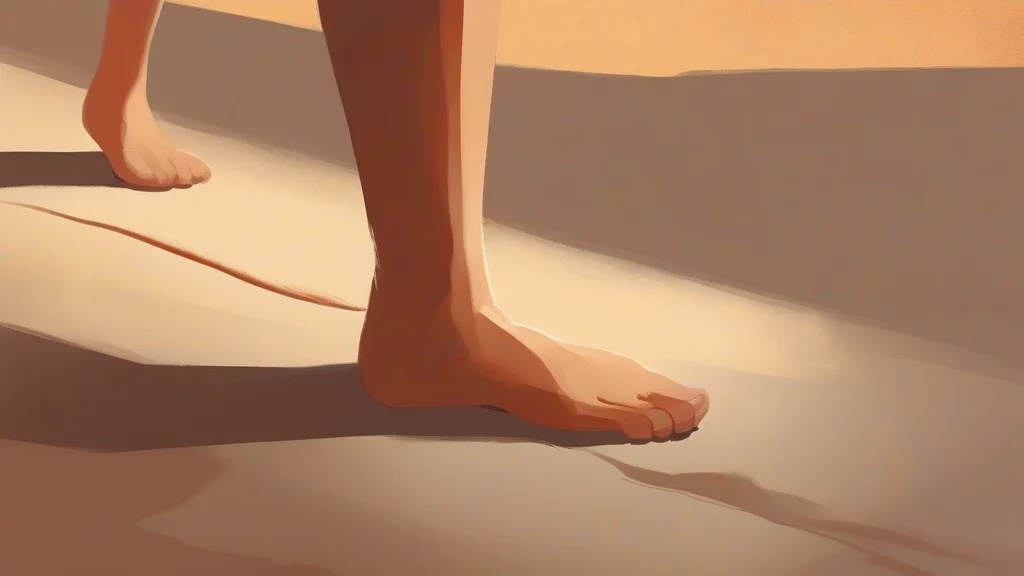
What does barefooted mean?
Barefooted describes a person whose feet are uncovered — wearing neither shoes nor socks — and it can also serve adverbially to describe the act of moving without footwear. It is a close variant of the far more common word barefoot, with which it shares both meaning and origin: the adjective bare combined with foot, formed as a compound before acquiring its participial-style ending. In practice, barefooted appears most often in literary prose, regional American speech, and older writing, while everyday English now overwhelmingly favors barefoot. The word carries connotations of simplicity, freedom, childhood summers, poverty, or closeness to nature depending on context — walking barefooted along a beach suggests leisure, while doing so out of necessity suggests hardship. Writers who choose barefooted over barefoot often do so for rhythm, emphasis, or a deliberately traditional tone.
Having no shoes or socks on; with the feet uncovered.
"He stood barefooted on the cold kitchen tiles."
Often interchangeable with barefoot, though barefoot is the more common modern choice.
In such a way as to be wearing no footwear; going or moving without shoes.
"The boys waded barefooted into the shallow creek."
Adverbial use typically places barefooted directly after the verb it modifies.
Barefooted is essentially 'barefoot' wearing a slightly older coat — same meaning, same roots, just a form that modern English has largely left behind.
Reviewed by Deb Chak, Editor. AI-assisted content curated by RJS Tech Solutions LLP.
Etymology of barefooted
Barefooted is formed from the Old English elements bær (bare) and fōt (foot), which were compounded into the adjective barefoot; the -ed ending was later added to create this variant form. Both barefoot and barefooted have been used in English for centuries, with barefoot ultimately becoming the dominant form. Cognate compound patterns appear in other Germanic languages, reflecting the shared Germanic roots of bare and foot.
Related word forms
How barefooted is actually used
Barefooted is a legitimate but less common variant of barefoot; in contemporary writing barefoot is usually preferred, though barefooted survives in literary, regional American, and older texts. When used adverbially it typically follows the verb ('to go barefooted').
Easily confused with barefooted
Barefoot and barefooted mean the same thing, but barefoot is far more common in modern usage, while barefooted is a slightly more formal or older variant.