What does bargee mean?
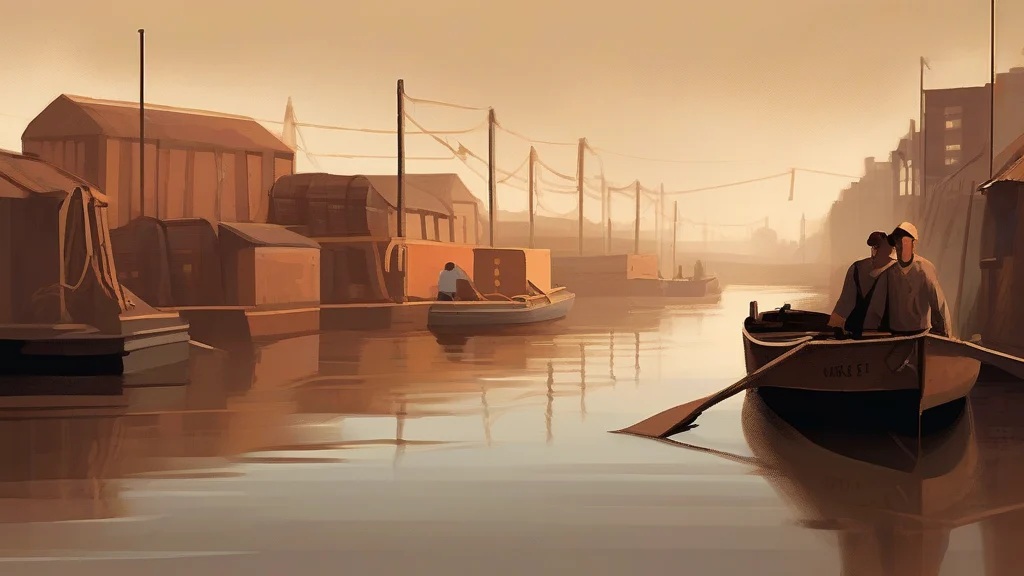
A bargee is a person who owns, operates, or works on a barge — a flat-bottomed boat used chiefly for transporting heavy goods along canals and rivers. The term is most closely associated with Britain, where bargees formed a distinctive occupational community during the industrial era, often living aboard their boats with their families and moving coal, timber, and other freight between towns. Because whole families frequently worked the boats together, the word carries rich cultural associations: traditional bargees developed their own dialect, customs, and the celebrated 'roses and castles' painting style that adorned their cabins and water cans. Today the occupation has largely given way to leisure boating, so bargee is encountered mainly in historical contexts, literature, and among the modern canal-boating community. It is a concrete, evocative noun that instantly conjures images of slow-moving cargo vessels, towpaths, and locks.
nounA person who owns, operates, or works on a barge, especially a cargo-carrying flat-bottomed boat on canals or rivers.
- A person who owns, operates, or works aboard a barge, especially carrying goods on canals or rivers.
- By extension, someone who lives aboard a barge as a way of life.
"The old bargee steered his narrowboat through the lock with practiced ease."
"The bargee guided his heavily laden craft through the narrow canal tunnel by 'legging' it along the walls."
"As a young bargee on the Thames, he learned every reach of the river between London and Oxford."
Standard plural; simply add -s.
"The festival brought together bargees from across the canal network."
Traditional canal bargees decorated their boats with the brightly painted 'roses and castles' folk art that still charms canal-side visitors today.
Reviewed by Deb Chak, Editor. AI-assisted content curated by RJS Tech Solutions LLP.
Etymology of bargee
Bargee derives from barge, with the suffix -ee denoting a person connected with something. The word barge itself traces back through Old French bargue to medieval Latin barca, the same root that gave English embark and barcarole. The term for the boatman emerged in English usage around the early 17th century, when river and canal transport became central to commerce.
How bargee is actually used
The word has a strongly traditional, working-class flavor in Britain, where it evokes the heyday of canal transport in the 18th and 19th centuries; it is somewhat dated today but remains current among canal enthusiasts and in historical writing.
Easily confused with bargee
A barge is the flat-bottomed boat itself, while a bargee is the person who lives on or operates it.