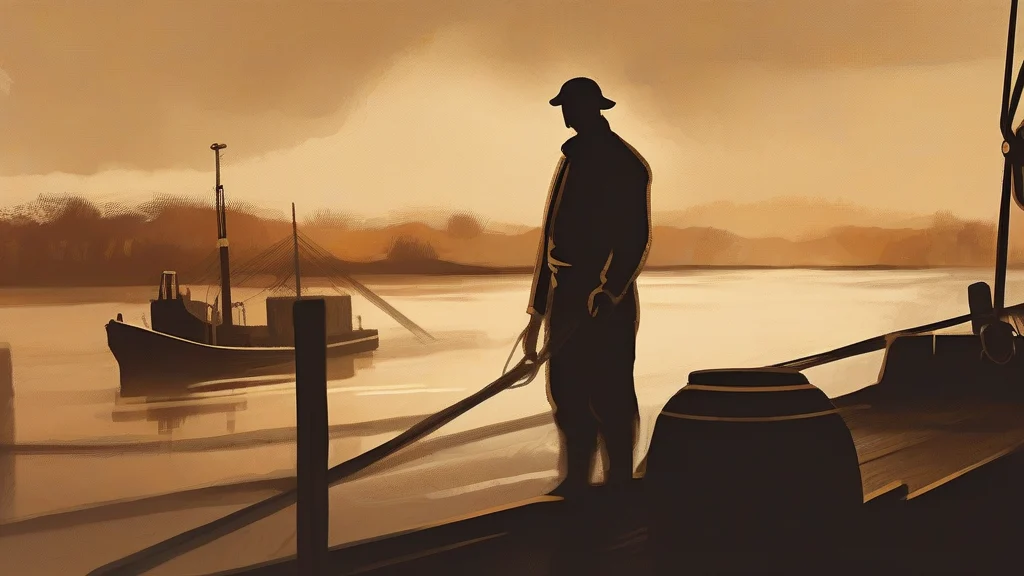
What does bargeman mean?
A bargeman is a man whose trade is the operation of a barge — a flat-bottomed vessel designed to carry heavy cargo such as coal, grain, timber, or aggregates along canals, rivers, and sheltered coastal waters. The term evokes an era when inland waterways were the arteries of commerce, particularly in Britain, where networks like the Grand Union Canal and the Thames depended on skilled bargemen to move goods before road and rail transport took over. The work demanded practical seamanship: handling locks, reading tides, and steering heavily laden craft through tight channels. Today the word survives largely in historical, literary, and regional contexts, and its gendered form has given way in modern usage to neutral terms like barge operator. Related words include lighterman and waterman, which describe similar trades on specific waters.
nounA man whose occupation is operating or working aboard a barge, typically transporting goods along rivers, canals, or coastal waters.
- A man employed to operate or work on a barge, especially for carrying goods on canals, rivers, or coastal waters.
"The bargeman guided his heavily laden craft through the narrow canal lock with practiced ease."
"The bargeman poled his narrowboat steadily through the misty morning on the Grand Union Canal."
"In the heyday of river trade, a skilled bargeman could navigate a loaded coal barge down the Thames using little more than tide charts and experience."
The standard plural follows regular noun formation; note that the final '-men' reflects the masculine '-man' suffix rather than a simple '-s' addition.
"The bargemen gathered at the pub after a long day's run down the canal."
For centuries, bargemen were the truck drivers of their day — moving coal, grain, and timber along Europe's canals long before railways and roads took over.
Reviewed by Deb Chak, Editor. AI-assisted content curated by RJS Tech Solutions LLP.
Etymology of bargeman
Bargeman is a straightforward English compound formed from 'barge' plus 'man', following the pattern of other occupational compounds such as boatman and seaman. The word 'barge' itself entered Middle English from Old French, ultimately tracing back through Romance maritime vocabulary to the Latin 'barca', a small ship — the same root that gives us 'barque' and the verb 'embark'. The compound arose during the period when barge transport was central to inland trade, and its plural form is 'bargemen'.
Related word forms
How bargeman is actually used
The word carries a somewhat traditional, working-class connotation tied to the historic canal and river trade, and it appears most often in British contexts, where canal culture remains well documented. It is a gendered occupational term; modern usage tends toward neutral alternatives such as 'barge operator' or 'barge crew'.
Easily confused with bargeman
A boatman works on boats in general, while a bargeman specifically works on barges — flat-bottomed cargo vessels used on canals, rivers, and coastal waters.
A bargee is simply another term for someone who works on or lives aboard a barge, whereas 'bargeman' more specifically denotes a male worker employed to operate one.