What does barrelled mean?
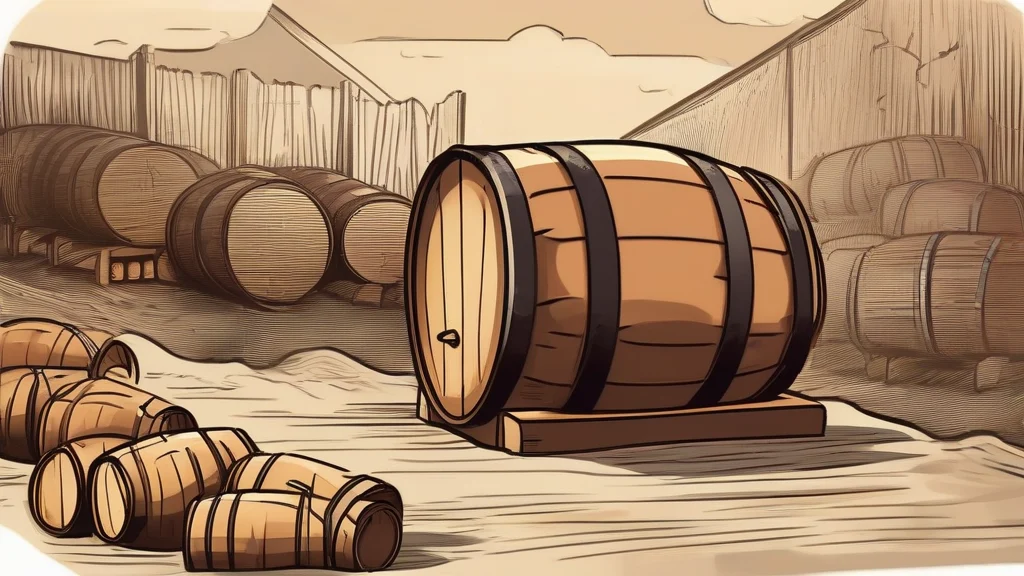
Barrelled describes something that has been fitted with, stored in, or shaped like a barrel. Most familiarly, it appears in compound forms such as a double-barrelled shotgun, which fires through two barrels, or a double-barrelled surname, which joins two family names with a hyphen. The word also serves as the past tense of the verb 'to barrel': goods such as wine, oil, or gunpowder were historically barrelled for transport and storage, and in informal modern usage someone who 'barrelled' down a road travelled at breakneck speed. British spelling doubles the final consonant to give 'barrelled', while American English writes 'barreled'. The underlying noun, barrel, entered English from Old French, ultimately tracing back to medieval Latin, and gave rise to a whole vocabulary of casks, kegs, and vats.
Fitted with a barrel or barrels, or shaped like a barrel.
"The antique double-barrelled rifle was the centrepiece of the collection."
Most often encountered in the compounds 'double-barrelled' and 'single-barrelled'.
Past tense of 'barrel': to put into a barrel, or (informally) to move very fast.
"They barrelled the cider immediately after pressing the apples."
A 'double-barrelled' name isn't just a surname with a hyphen — the phrase literally borrows from shotguns with two barrels.
Reviewed by Deb Chak, Editor. AI-assisted content curated by RJS Tech Solutions LLP.
Etymology of barrelled
The word derives from 'barrel', which entered Middle English from Old French 'baril', a term for a small cask whose further origin lies in medieval Latin (compare 'barile'). The adjective and past-tense forms arose naturally as English doubled the final consonant before adding '-ed'. Cognate forms survive across the Romance languages, including French 'baril', Italian 'barile', and Spanish 'barril', all denoting a cask or drum.
Related word forms
How barrelled is actually used
British English doubles the 'l' ('barrelled'), while American English uses a single 'l' ('barreled'). The informal sense of moving at high speed carries a colloquial register and appears mostly in narrative or journalistic writing.
Easily confused with barrelled
'Barreled' is simply the American spelling of the same word, with one 'l', while 'barrelled' uses two 'l's in British English.