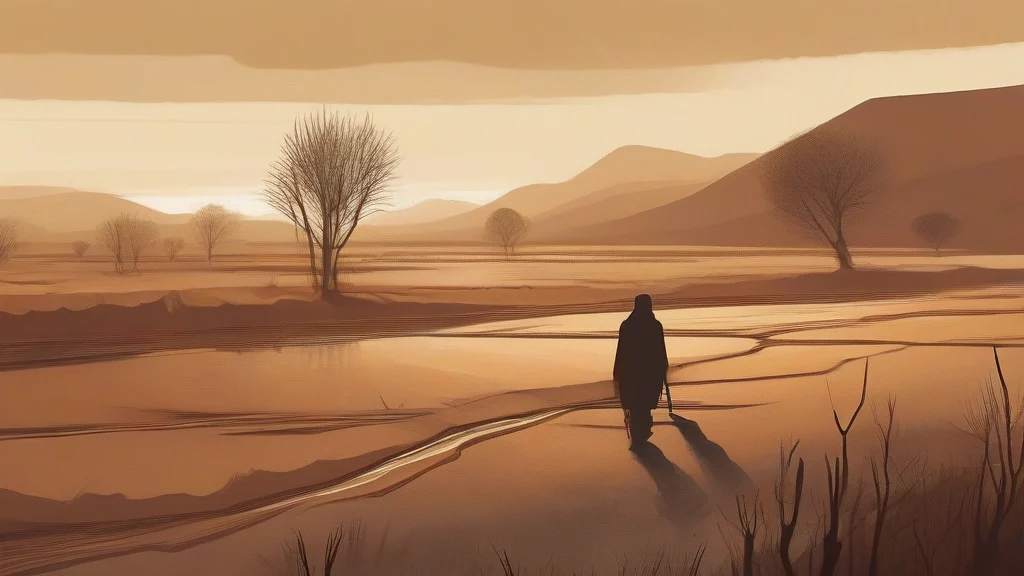
What does barren mean?
Barren is an adjective describing something that produces little or nothing: most literally, land too poor in soil or water to sustain vegetation, and by extension, people or animals unable to bear offspring. It also works figuratively for anything unproductive or devoid of interest, such as a barren stretch of conversation or a barren period in a writer's career. The word carries connotations of emptiness, desolation, and loss — a barren landscape feels bleak and abandoned, while its older use for childless women now sounds archaic and even insensitive, so modern writers tend to reserve it for terrain and figurative uses. Common collocations include "barren land," "barren landscape," and "barren wasteland." Its antonyms are fertile, fruitful, and lush. Derived forms include the nouns barrenness and barrens (the latter used for regions of unproductive ground, such as the pine barrens of New Jersey) and the adverb barrenly. Barren entered English from Old French during the Middle Ages and remains a vivid, evocative term for sterility and absence.
(of land) too poor to produce much or any vegetation; (of a person or female animal) unable to bear young; (figuratively) yielding no useful result or lacking interest.
"They struggled to farm the barren plateau, where little survived the dry summers."
An area of unproductive, often treeless land; usually encountered in the plural form "barrens."
"The settlers crossed the barrens before reaching fertile ground along the river."
The noun sense appears chiefly in the fixed plural "the barrens," used in place names such as the New Jersey Pine Barrens.
As a noun, barren typically appears in the plural "barrens," referring to tracts of unproductive land, especially in regional place names.
"Moose and rare orchids thrive in the pine barrens despite the poor soil."
The word "barren" comes from the same Old French root that gave us "baron" — two words that sound almost identical yet mean nearly opposite things: one is a lord of plenty, the other land that yields nothing.
Reviewed by Deb Chak, Editor. AI-assisted content curated by RJS Tech Solutions LLP.
Etymology of barren
Barren came into Middle English from Old French "barain" (also spelled "baraigne"), meaning sterile or infertile. The ultimate origin of the Old French word is uncertain; it has been speculated to derive from a Gaulish or pre-Roman substrate, but this is not established. Despite the near-identical sound, it is not related in meaning to "baron," which comes from a different medieval Latin root.
Related word forms
How barren is actually used
When applied to women, "barren" carries heavy historical and emotional weight and can sound harsh or dated in modern contexts; neutral medical or empathetic phrasing (e.g., "unable to conceive") is often preferred today. Applied to land, it is standard and neutral in both everyday and scientific usage.
Easily confused with barren
"Baron" is a noun meaning a nobleman of high rank, while "barren" is an adjective describing land or beings as infertile or unproductive.