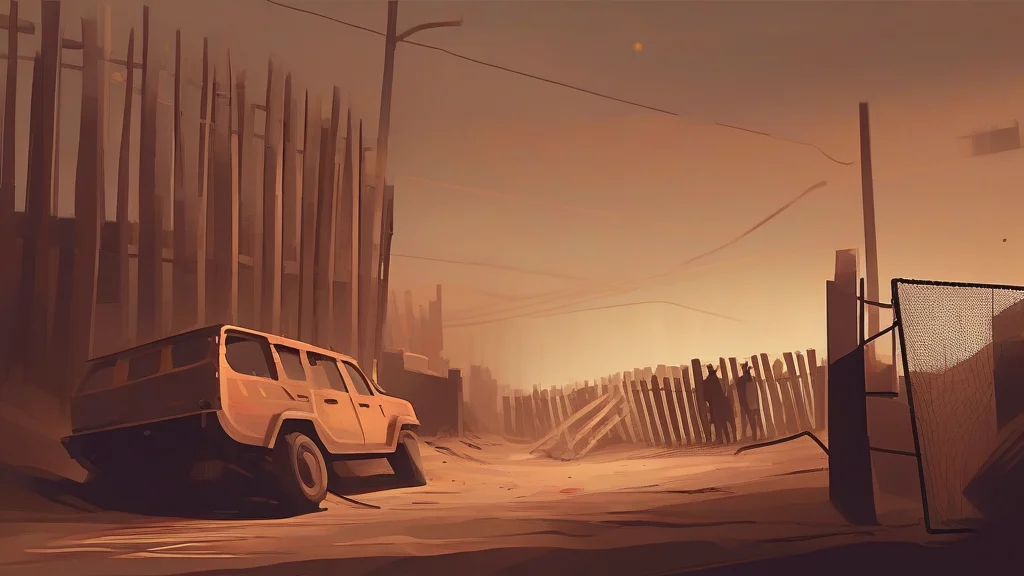
What does barricade mean?
A barricade is a barrier—usually hastily or roughly constructed from whatever materials lie at hand, such as barrels, furniture, vehicles, or debris—that is placed across a road, street, doorway, or other route in order to block movement or defend a position. The word also works as a verb: to barricade a place is to seal it off behind such obstacles. Barricades appear most often in contexts of protest, riot, war, and siege, giving the word vivid connotations of confrontation and resistance, though they are also used in everyday emergencies, as when people barricade doors against storms or intruders. Derived from the French 'barrique', meaning barrel, the term entered English in the early seventeenth century and has been inseparable from images of street uprisings ever since. It remains a powerful, concrete word for obstruction, defense, and defiance.
An improvised barrier erected across a road, street, or entrance to block passage or serve as a defensive position.
"Soldiers took cover behind the barricade at the end of the boulevard."
To block or seal off a place by building barriers across its entrances.
"They barricaded themselves inside the building until morning."
The plural is standard and common, especially in phrases like 'behind the barricades' or 'the police cleared the barricades'.
"Crowds gathered behind the barricades to watch the parade."
The word 'barricade' was born on the streets of Paris in 1588, when rebels stacked barrels ('barriques') across their streets — and the word has been tied to uprising ever since.
Reviewed by Deb Chak, Editor. AI-assisted content curated by RJS Tech Solutions LLP.
Etymology of barricade
'Barricade' comes from the French 'barricade', derived from 'barrique', meaning barrel, because the first street barricades were famously made from stacked barrels. The word entered English in the early seventeenth century, shortly after the Parisian street fighting of 1588 that gave the term its name. Its root connects it etymologically to 'barrier' and ultimately to words denoting bars and obstructions.
Related word forms
How barricade is actually used
The noun is neutral in register but carries strong connotations of civil unrest, protest, or siege; it is a staple of journalism about riots and revolutions. As a verb, 'barricade' is often used reflexively in safety advice ('barricade yourself inside'), especially in emergency contexts. The plural 'barricades' frequently appears in set phrases such as 'behind the barricades'.
Easily confused with barricade
A barrier is any general obstruction (physical or abstract), while a barricade specifically denotes a hastily improvised structure built to block movement or defend a position.
A blockade is a broader act of sealing off an area, port, or supply route (often military or naval), whereas a barricade is the physical structure itself.