What does bascule mean?
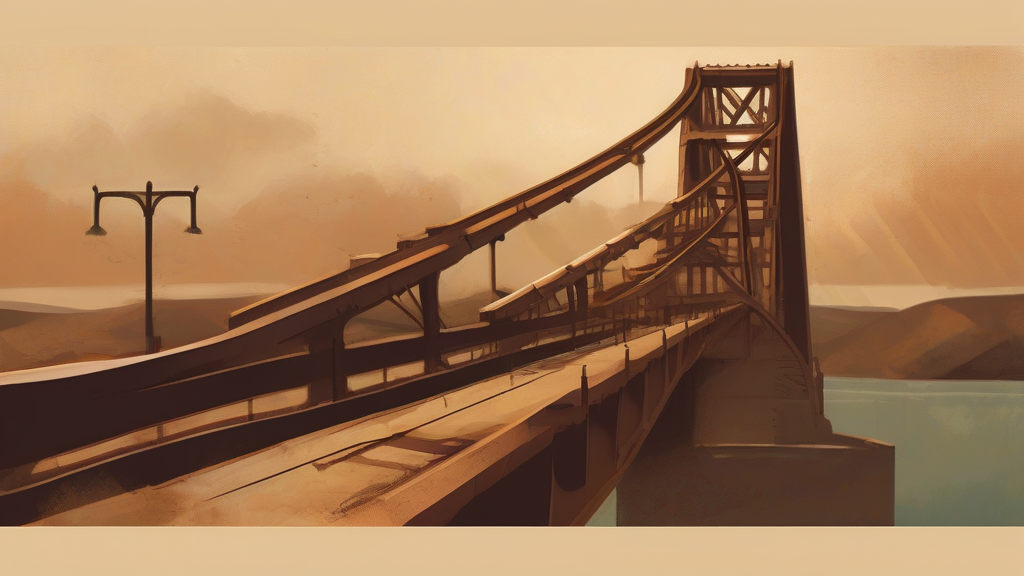
A bascule is a movable structure that operates on the principle of a seesaw, in which a load is raised or lowered by means of a counterweight. The term is encountered almost exclusively in engineering contexts, above all in the phrase 'bascule bridge' — a type of drawbridge whose deck pivots upward about a horizontal axis, balanced by heavy counterweights housed in piers on either side. Famous examples include London's Tower Bridge and Chicago's many river crossings, which made the bascule the dominant movable-bridge form in early twentieth-century America. The word comes from French, where it originally denoted a seesaw or balance, combining elements meaning 'low' and 'bottom'. Because the counterweight does most of the work of lifting, bascule bridges can be raised quickly and with relatively little power, which explains their enduring popularity for busy waterways. For general readers, 'bascule' is essentially shorthand for the familiar counterweighted drawbridge.
nounA device or structure that works on the principle of a seesaw, in which a weight counterbalances a load; most commonly, a type of drawbridge raised by means of counterweights.
- A type of movable bridge whose deck (or leaves) pivots upward on a horizontal axis, balanced by counterweights — the standard sense in modern English.
- A mechanism operating on the seesaw principle, in which a moving part is counterbalanced by a weight (rare, mostly technical or historical).
"The Tower Bridge in London is perhaps the world's most famous bascule bridge, its massive roadways lifted by hidden counterweights."
"Engineers chose a double-leaf bascule design so ships could pass through the harbour entrance without delay."
"The old canal lock still uses a simple wooden bascule to raise and lower its gate."
Regular plural; typically refers to multiple bridges or bridge leaves rather than abstract instances.
"Chicago's river once carried more than fifty bascules, more than any other city in the world."
London's Tower Bridge isn't a suspension bridge at all — it's a giant pair of steel seesaws, each leaf weighing over a thousand tonnes yet rising in under a minute thanks to counterweights.
Reviewed by Deb Chak, Editor. AI-assisted content curated by RJS Tech Solutions LLP.
Etymology of bascule
Bascule entered English from French in the nineteenth century, borrowed alongside the engineering technology it describes. The French word itself combines 'bas-' (from Latin 'bassus', meaning low) with '-cule', related to 'cul' (bottom, from Latin 'culus'), so the original sense was something like 'seesaw' — a plank tipping on its lowest point. Its closest relatives are therefore words built on the same Latin roots, such as 'base', 'bass', and 'abase'.
How bascule is actually used
Bascule is a technical term used mainly in civil engineering and architecture; outside discussions of bridges it is rare. It is always a countable noun and carries a neutral, formal register.
Easily confused with bascule
A cantilever bridge extends from anchored supports without counterweights, whereas a bascule bridge opens by pivoting like a seesaw balanced on counterweights.
A basilica is a large church or public building, unrelated in meaning to bascule despite a similar opening sound.