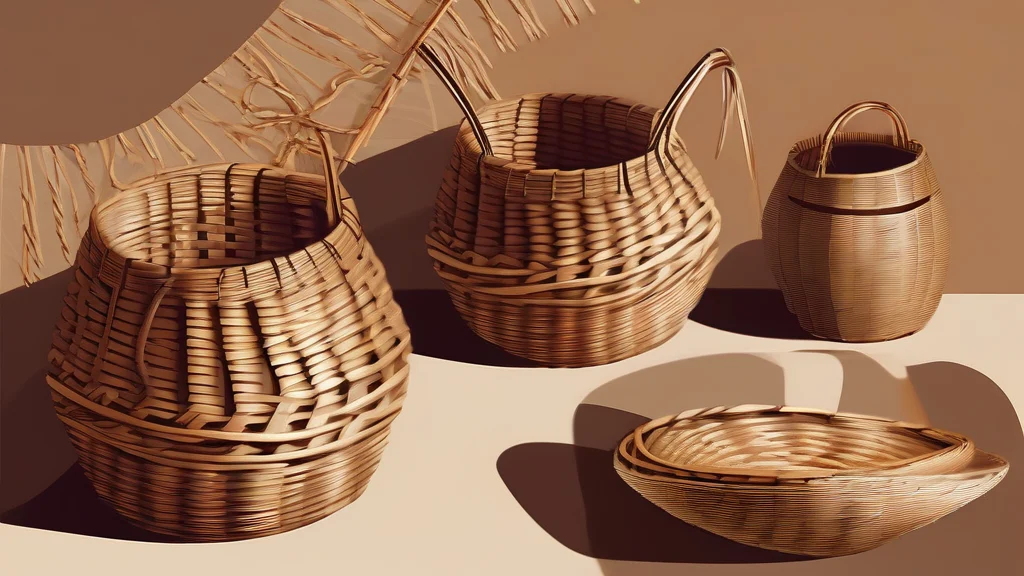
What does basketry mean?
Basketry is the craft of making baskets and related objects by weaving pliable natural materials such as willow, cane, reed, straw, or bamboo. It can refer both to the activity itself — the skill and techniques of interlacing flexible strands — and to woven work regarded collectively as a category of craft or art. The term appears most often in discussions of traditional crafts, anthropology, museums, and artisan economies: one might speak of Native American basketry, Japanese bamboo basketry, or the revival of willow basketry among contemporary makers. Because it names an uncountable practice, the word takes no plural and is typically used in phrases like "the art of basketry." Its connotations are largely positive, suggesting patience, heritage, and skilled handwork passed between generations. As one of the oldest human crafts — older than pottery in most regions — basketry connects modern makers to a deep history of working with renewable plant fibers.
nounThe craft or process of making baskets and other objects by weaving pliable materials such as willow, cane, reed, or bamboo; also, baskets collectively considered as products of this craft.
- The craft or skill of weaving materials such as willow, cane, reed, or bamboo into baskets and similar objects.
- Baskets collectively, or woven work regarded as a category of craft or art.
"Her knowledge of traditional basketry had been passed down through four generations of weavers."
"The museum's collection includes fine examples of Native American basketry from the Pacific Northwest."
"She studied bamboo basketry in Kyoto under a master weaver."
Rarely pluralized; basketry functions as an uncountable mass noun referring to the craft or body of woven work. A plural form occasionally appears in scholarly writing to distinguish regional or cultural traditions.
"The exhibition surveyed the distinct basketries of several coastal communities."
Basketry may be humanity's oldest craft — woven artifacts predate pottery, yet because plant fibers decay, almost nothing survives for archaeologists to find.
Reviewed by Deb Chak, Editor. AI-assisted content curated by RJS Tech Solutions LLP.
Etymology of basketry
Basketry derives from "basket," whose ultimate origin is uncertain, though it has been linked since early scholarship to the Latin "bascauda" (a woven vessel), itself possibly borrowed from Celtic. The word entered English via French during the medieval period, with the suffix "-ry" forming nouns denoting a craft or collective product, as in pottery and joinery. It has been used in English since at least the mid-nineteenth century as the standard term for the weaving craft.
How basketry is actually used
Basketry is an uncountable (mass) noun with no plural in ordinary use; it carries a neutral-to-positive connotation, often evoking artisanal craft, heritage traditions, and material culture. It appears frequently in ethnographic, anthropological, and craft contexts rather than everyday conversation.
Easily confused with basketry
A bakery is a place where bread and cakes are baked and sold, while basketry is the craft of weaving baskets.