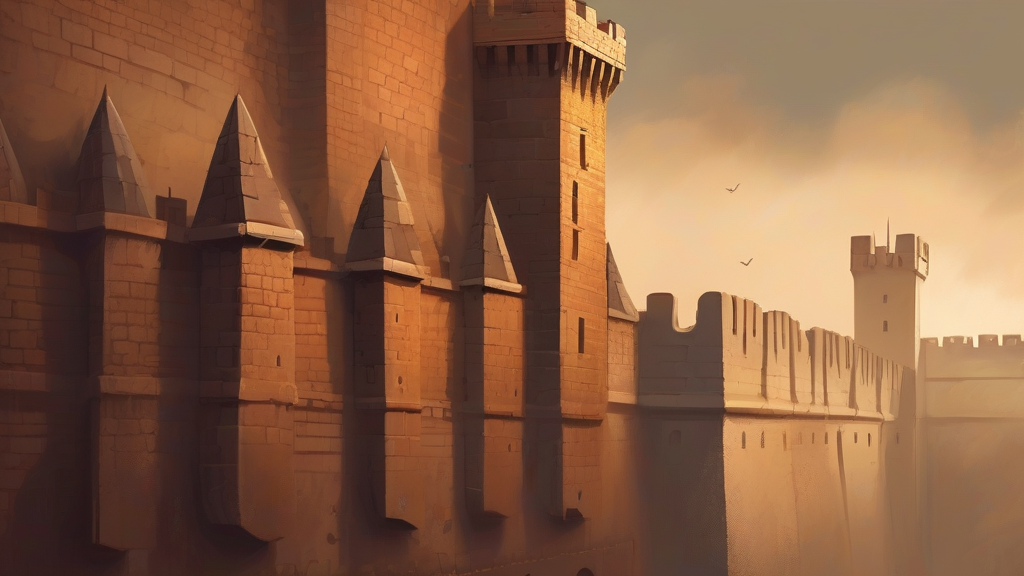
What does battlement mean?
A battlement is the distinctive notched parapet that runs along the top of a castle wall, tower, or fortress rampart. It consists of a repeating pattern of low, solid upright blocks called merlons and open gaps called crenels, and this combination is known as crenellation. The design was functional rather than ornamental: defenders could shelter behind the merlons while shooting through the crenels, gaining protection without losing a clear line of fire. In everyday English, the word almost always appears in the plural — visitors walk 'along the battlements' or admire a skyline 'fringed with battlements' — because it refers to the whole crenellated parapet rather than a single notch. Though its military purpose has faded, the silhouette remains so strongly associated with castles that builders added purely decorative battlements to churches, mansions, and even civic buildings for centuries. Figuratively, the word evokes defense, siege, and medieval romance.
nounA battlement is a parapet at the top of a wall or tower, especially of a castle or fortress, having a regular series of squared openings (crenels) alternating with raised solid sections (merlons), built originally to shelter defenders.
- A fortified parapet with alternating crenels and merlons on the top of a castle wall or tower, used to protect defenders while allowing them to shoot.
- (Usually in the plural) The crenellated walls of a castle or similar building collectively, as in 'walking along the battlements.'
"From the battlement, the sentry watched the road for signs of approaching cavalry."
"The soldiers crouched behind the battlements, loosing arrows through every crenel."
"Tourists can still walk the ancient battlements that crown the city walls."
The plural is by far the more common form in actual usage, since the word normally refers to an entire crenellated parapet rather than a single notch-and-block unit.
"They stood on the windswept battlements, looking out over the surrounding countryside."
Those decorative square teeth on top of castles weren't decoration at all — each gap was a firing position and each solid block was a shield, making the battlement medieval Europe's most elegant piece of safety equipment.
Reviewed by Deb Chak, Editor. AI-assisted content curated by RJS Tech Solutions LLP.
Etymology of battlement
The word entered English in the Middle Ages from Old French 'bataillement', derived from 'batailler', meaning to fortify with battlements, which in turn comes from 'bataille' — battle. The ultimate root is the Late Latin verb 'battuere', meaning to beat or strike. This makes 'battlement' a direct relative of 'battle' itself, as well as of words like 'embattle' and 'battalion', all descended from the same martial lineage.
Related word forms
How battlement is actually used
The word is almost always used in the plural ('battlements'), since a single opening-and-block unit is rarely referred to alone; the singular 'battlement' typically appears in technical architectural discussion. The individual parts have their own precise names: the gaps are 'crenels' (or embrasures) and the raised sections are 'merlons'. The register leans formal, literary, or historical.
Easily confused with battlement
A rampart is a broad defensive bank or wall of a fortress, while a battlement is specifically the notched parapet running along the top of such a wall.