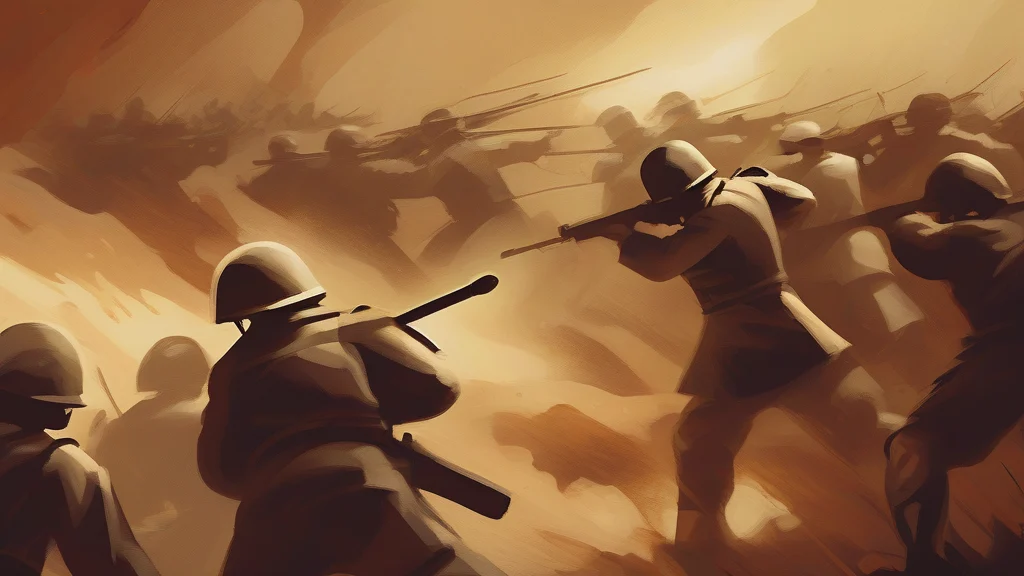
What does battle mean?
A battle is a sustained fight between organized armed forces, usually fought on a large scale as part of a wider war, such as the Battle of Waterloo or the Battle of Gettysburg. Beyond its military core, the word extends naturally to any prolonged struggle between opponents — whether people, teams, institutions, or ideas — so one may speak of a legal battle, a political battle, a battle of wills, or a personal battle against illness. As a verb, 'to battle' means to fight or struggle tenaciously against something, often used in the sense of courageously confronting hardship. The word carries connotations of intensity, endurance, and stakes; a battle implies more than a brief skirmish but less than an entire war. This flexibility makes it one of English's most versatile words for conflict, appearing constantly in history writing, sports commentary, business reporting, and everyday conversation about personal challenges.
A sustained fight between organized armed forces; by extension, any prolonged struggle between opposing forces, people, or ideas.
"Historians still debate the tactics that decided the Battle of Hastings."
Often capitalized when referring to a specific named historical engagement (e.g., the Battle of Midway).
To fight or struggle tenaciously against someone or something.
"Rescue crews battled through the night to reach survivors trapped in the rubble."
Commonly used figuratively, especially in contexts like illness or competition ('battling cancer').
The plural 'battles' refers either to multiple distinct military engagements or, figuratively, to several separate struggles a person faces over time.
"The museum chronicles the great naval battles of the twentieth century."
The word 'battle' comes from the same Latin root as 'battery' — which is why a gun battery and a pitched battle are distant cousins.
Reviewed by Deb Chak, Editor. AI-assisted content curated by RJS Tech Solutions LLP.
Etymology of battle
Battle entered Middle English in the late medieval period, borrowed from Old French 'bataille', which itself derives from Late Latin 'battalia' meaning combat or fighting. That Latin term ultimately traces back to 'battere' (to beat), from Latin 'batuere'. The same beating root gives us related English words including 'battalion', 'battery', 'combat', and 'abate', all sharing this ancient notion of striking or beating down.
Related word forms
How battle is actually used
As a noun, 'battle' carries connotations of scale and organization — a skirmish or clash is smaller than a battle. Figurative uses ('a battle with addiction', 'the battle for hearts and minds') are extremely common in journalism and everyday speech. As a verb, 'battle' is informal-to-neutral and often appears in progressive forms ('is battling'). In British English, 'battle' can also colloquially mean an advantage or improvement in a difficult situation, though this is dated.
Easily confused with battle
A battalion is a specific military unit of several hundred soldiers, whereas a battle is the fight or engagement itself.
A bout is a short contest or match, especially in boxing or illness, while a battle implies a larger, more sustained struggle.