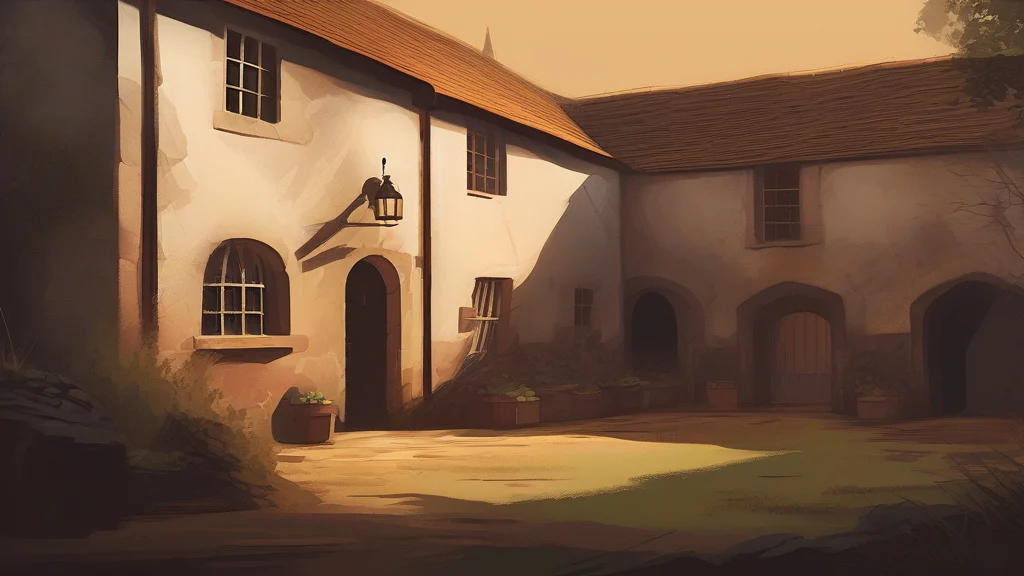
What does bawn mean?
A bawn is a fortified enclosure or courtyard surrounding a farmhouse, castle, or other dwelling, most closely associated with the plantations of early 17th-century Ireland. Typically rectangular and surrounded by high stone walls with projecting corner towers known as flankers, the bawn served both as a defensive refuge against attack and as a secure yard for livestock, particularly cattle. The term derives from the Irish phrase meaning roughly 'cow-fortress', reflecting its original agricultural-defensive purpose. Many surviving examples, such as those at Bellaghy in County Londonderry, are now protected historic monuments and important sources for archaeologists studying the plantation period. Though essentially obsolete in everyday use, the word remains current in Irish heritage, tourism, and scholarly contexts, where it denotes this distinctive form of vernacular fortification that shaped the rural landscape of Ulster and beyond.
nounA bawn is an enclosed courtyard or defensive space surrounding a farmhouse or castle, especially the fortified enclosure built around planters' houses in 17th-century Ireland.
- A fortified enclosure or courtyard surrounding a farmhouse or castle, especially in 17th-century Ireland.
- (By extension) the farmyard or enclosed ground attached to such a dwelling.
"The ruins of the plantation castle still stand within the grass-grown bawn, its thick walls pierced by musket loops."
"Visitors can walk the full circuit of the bawn at Bellaghy, whose corner flanker towers still guard the site."
"The cattle were driven inside the bawn each night to protect them from raiders."
The standard plural; used mainly in archaeological and historical surveys describing multiple sites.
"Several well-preserved bawns survive across Counties Antrim and Londonderry."
The word 'bawn' literally descends from the Irish for 'cow-fort' — because in 17th-century Ulster, protecting your cattle was quite literally a matter of life and death.
Reviewed by Deb Chak, Editor. AI-assisted content curated by RJS Tech Solutions LLP.
Etymology of bawn
The word 'bawn' entered English from Irish during the early 17th century, when English and Scottish settlers built fortified farmsteads across Ulster. It derives from the Irish 'bábhún' (also anglicised as 'bawne'), a compound of 'bó' meaning cow and 'dún' meaning fort or enclosure — hence its literal sense of a 'cow-fort'. The spelling 'bawn' became standard through its use in plantation-era documents and maps describing these defensive enclosures.
How bawn is actually used
The word is chiefly of historical and regional interest, appearing in discussions of Irish plantation architecture and archaeology rather than in everyday speech. Outside Ireland it is rare and typically encountered in heritage or academic writing.
Easily confused with bawn
A yawn is an involuntary deep breath taken when tired or bored, while a bawn is a fortified enclosure around a building in Ireland.
A pawn is a chess piece or something pledged as security for a loan, whereas a bawn is a walled enclosure surrounding a farmhouse or castle.