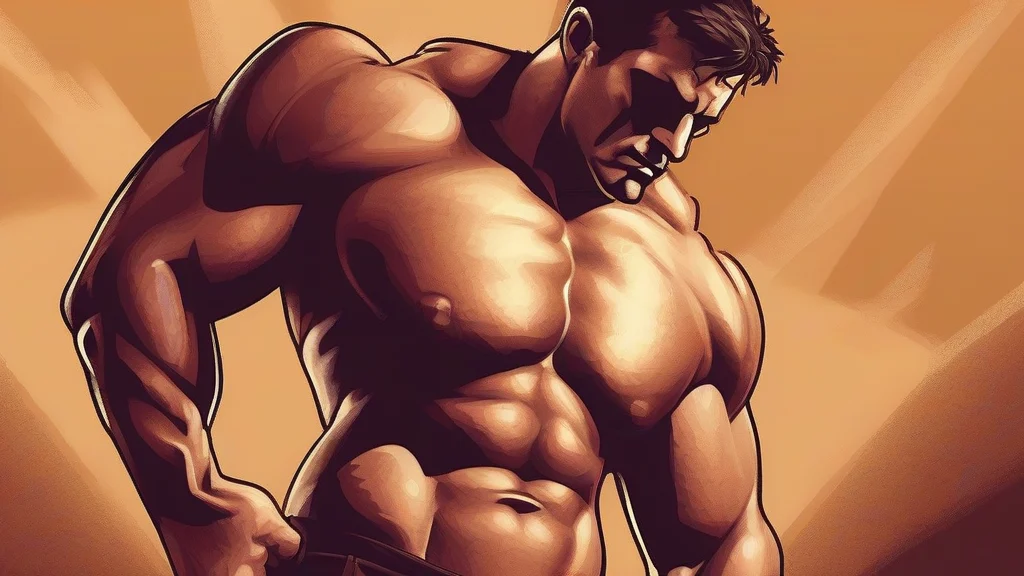
What does beefcake mean?
Beefcake is an informal noun denoting a powerfully muscular man, particularly one whose physique is displayed for visual appreciation, as in bodybuilding contests, fitness magazines, or film roles that showcase a sculpted torso. The word arose in American English during the mid-twentieth century as a deliberate male counterpart to 'cheesecake', the earlier slang term for alluring photographs of women; where cheesecake celebrated glamour, beefcake celebrated bulk and brawn. The word can refer either to individual men ('the beach was crowded with beefcake') or collectively to such imagery and spectacle. Its tone is casual and often playful, sometimes carrying a whiff of objectification or camp, which makes it well suited to humorous or nostalgic commentary rather than serious description. Though less current than it once was, it survives readily in pop-culture writing about vintage physique magazines and action heroes.
A muscular, physically impressive man, especially one presented or photographed as an object of visual attraction.
"The casting call wanted genuine beefcake for the lifeguard roles."
Informal; often humorous and occasionally objectifying.
Imagery or portrayals featuring muscular men, considered collectively.
"The exhibition traced the history of beefcake in postwar American magazines."
Usually treated as an uncountable mass noun in this sense.
The plural applies to the countable sense (individual muscular men); the collective/imagery sense typically remains uncountable.
"The poster was plastered with bronzed beefcakes flexing on the sand."
'Beefcake' was invented in the 1940s purely as the masculine answer to 'cheesecake' — the slang term for glamorous women in pin-up photos.
Reviewed by Deb Chak, Editor. AI-assisted content curated by RJS Tech Solutions LLP.
Etymology of beefcake
Beefcake originated in American slang in the mid-1940s as a jocular compound of 'beef' (slang for muscular strength) and 'cake', modeled directly on 'cheesecake', which had been used since roughly World War I for pin-up images of attractive women. The coinage transferred the idea wholesale to men, swapping the sweet, decorative connotations of cheesecake for meaty solidity. It shares its second element with ordinary cake compounds like pancake and cupcake, but its true sibling is cheesecake, with which it forms a matched pair in twentieth-century popular culture.
How beefcake is actually used
Informal and somewhat dated in tone; often used humorously or slightly tongue-in-cheek today. It can carry mildly objectifying connotations, so register matters — fine in casual conversation or cultural commentary, out of place in formal writing.
Easily confused with beefcake
Cheesecake refers either to a dessert or, in its older slang sense, to images of attractive women, whereas beefcake is the male equivalent referring to muscular, physically attractive men.