What does beefsteak mean?
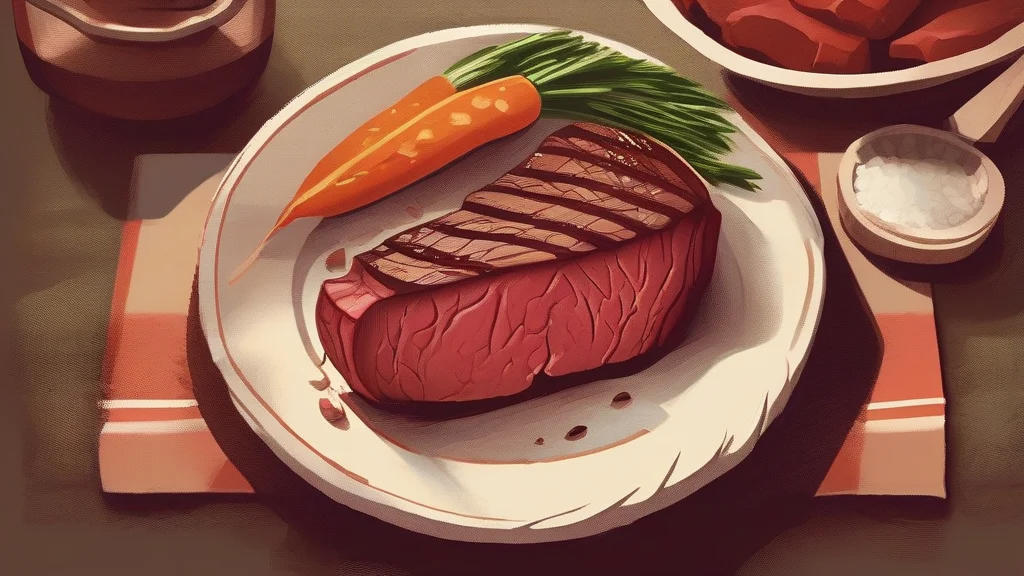
A beefsteak is a thick slice of beef prepared for cooking, most often by grilling, broiling, or frying. The word combines two older food terms: 'beef,' which entered Middle English through Old French, and 'steak,' borrowed from Old Norse. While modern speakers frequently shorten it to just 'steak,' the full form 'beefsteak' persists in several established contexts — notably in 'beefsteak tomato,' a variety prized for its large, meaty fruit that resembles a slice of beef in texture and color, and in traditional dishes such as beefsteak and kidney pudding in British cuisine. The term carries connotations of hearty, substantial eating and appears often in menus, cookery writing, and agricultural descriptions. It functions almost exclusively as a noun and remains a useful word for anyone describing cuts of meat or certain robust plant varieties with precision.
A thick slice of beef, especially one intended for grilling, broiling, or frying.
"The butcher recommended a well-marbled beefsteak for pan-searing."
Used attributively or as part of a compound name for large, fleshy fruits resembling beef in texture, especially the beefsteak tomato.
"We grew beefsteak tomatoes in the garden this summer."
Regular plural formation, used when referring to multiple slices or multiple varieties.
"The restaurant serves several different beefsteaks, each sourced from a different farm."
The word 'beefsteak' literally fuses two French-derived words — 'beef' from Old French bœuf and 'steak' borrowed from Old Norse steik — making it a rare English compound stitched from both Romance and Germanic threads.
Reviewed by Deb Chak, Editor. AI-assisted content curated by RJS Tech Solutions LLP.
Etymology of beefsteak
Beefsteak is a compound formed from 'beef,' derived via Anglo-Norman and Old French 'buef' from Latin 'bos' (ox), and 'steak,' borrowed in the Middle English period from Old Norse 'steik,' related to the verb 'steikja' meaning to roast on a stake. The compound emerged in English during the early modern period as cooks sought a specific term for a thick-cut piece of beef suitable for quick cooking over high heat. Its components reflect a layered etymology: Latin roots filtered through French supply the first element, while Norse borrowing supplies the second — a pairing characteristic of English vocabulary shaped by successive waves of conquest and trade.
How beefsteak is actually used
Primarily used in culinary contexts; the compound 'beefsteak tomato' is common in gardening and cooking. In everyday speech people more often say simply 'steak,' with 'beefsteak' used for emphasis or in set phrases.
Easily confused with beefsteak
Beefcake refers humorously to muscular, attractive men, while beefsteak is an actual slice of beef.