What does beet mean?
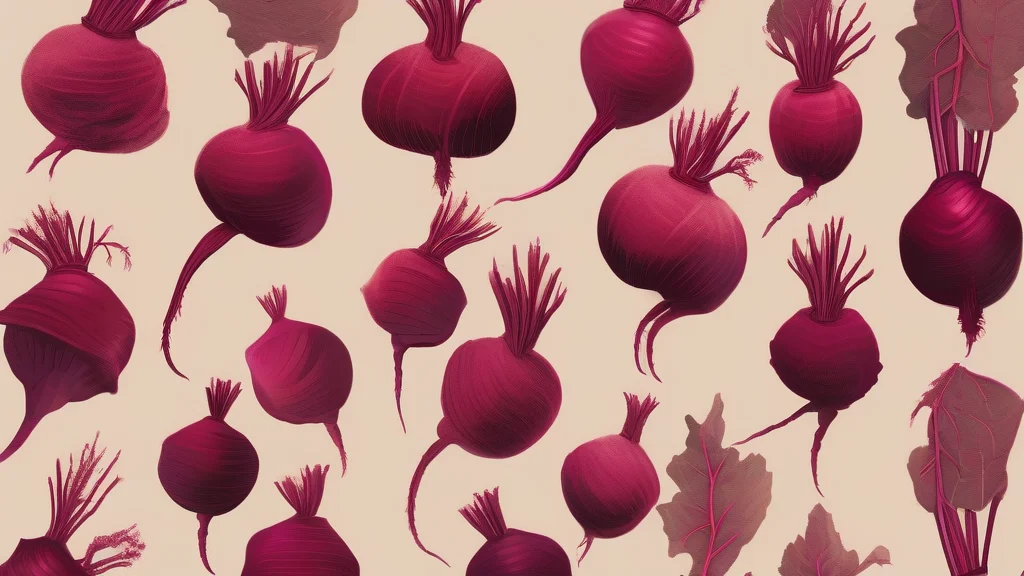
A beet is a root vegetable, the swollen taproot of the plant Beta vulgaris, prized both in the kitchen and in agriculture. In its most familiar form it is round or tapering, with skin ranging from deep crimson to golden, and flesh that stains anything it touches a vivid magenta. Cooked by roasting, boiling, or pickling, beets have an earthy sweetness that pairs well with sharp cheeses, citrus, and vinegar; they also star in Eastern European dishes such as borscht. Beyond the dinner table, specialised varieties are grown at scale: sugar beet supplies a large share of the world's sugar, while mangolds and other fodder strains feed livestock. The leafy tops, sold as beet greens or as chard, are edible too. In American English the word covers the whole vegetable, whereas British English tends to say beetroot for the root itself and keeps beet mostly for farming contexts. The near-homophone beat is an unrelated word.
nounA biennial plant of the amaranth family (Beta vulgaris), cultivated for its fleshy edible root and for its leaves; the root itself, typically dark red, eaten as a vegetable.
- The swollen, edible root of Beta vulgaris, usually deep red or purple, eaten cooked or pickled.
- The plant Beta vulgaris itself, including cultivated varieties grown for sugar production (sugar beet) or for livestock fodder (mangold/mangel-wurzel).
"She roasted the beets with olive oil and thyme until their edges caramelised."
"The salad combined roasted beets, goat's cheese, and toasted walnuts."
"Much of the region's farmland is given over to sugar beet."
"Borscht owes its vivid colour to grated beet simmered in the broth."
Regular plural. In British English, "beetroot" is frequently used as an uncountable mass noun when referring to the vegetable generally, so the plural is less common there.
"She grew rows of beets along the north edge of the garden."
The beet gave us sugar: before sugarcane dominated, much of Europe's sweetness was coaxed out of these humble, dirt-caked roots.
Reviewed by Deb Chak, Editor. AI-assisted content curated by RJS Tech Solutions LLP.
Etymology of beet
The word "beet" entered English in the Middle English period, borrowed from Old French "bete", which itself traces back to Latin "beta", the classical name for the plant. The Latin term likely passed into Romance from an earlier Mediterranean source. Its cousin "chard" derives separately from French, ultimately linked to the same botanical complex, while "beetroot" is a straightforward later compound. The spelling has been stable since early modern English, though confusion with "beat", from an entirely different Germanic root, persists to this day.
Related word forms
How beet is actually used
In American English, "beet" commonly refers to the root itself, while British English more often uses "beetroot" for the edible root and reserves "beet" chiefly for agricultural contexts such as sugar beet. The plural is regular ("beets"), though in British usage "beetroot" is often treated as an uncountable mass noun.
Easily confused with beet
"Beet" is a root vegetable (or the plant it grows on), while "beat" is a verb meaning to strike or defeat, or a noun meaning a rhythmic pulse.