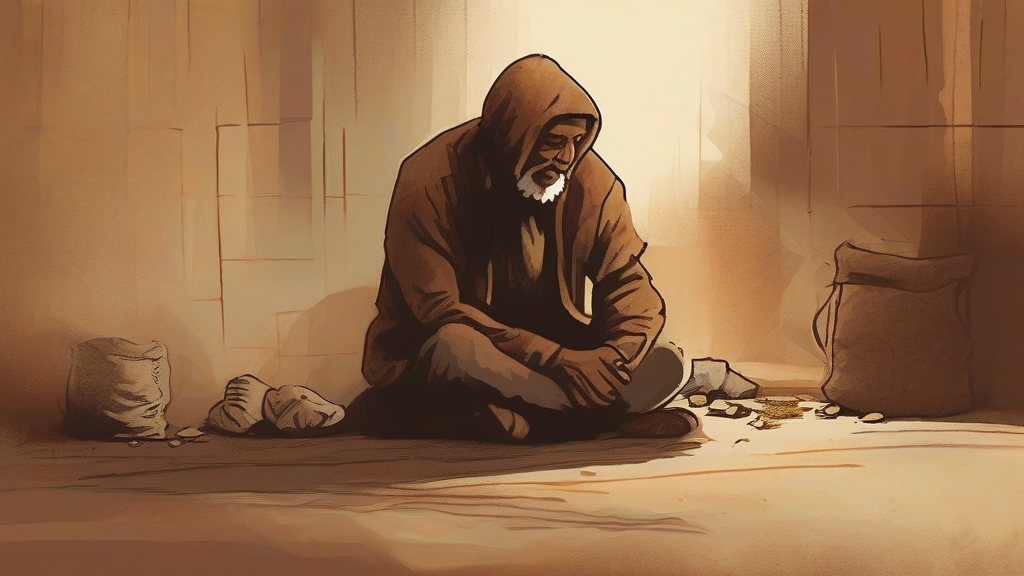
What does beggared mean?
"Beggared" is the past tense of "beggar," meaning to reduce someone or something to poverty. A failed harvest could beggar a farming family; ruinous taxes might beggar an entire province. Beyond its literal financial sense, the verb has developed a powerful figurative use: when something is so extreme that ordinary language cannot capture it, we say it 'beggars belief' or 'beggars description,' as though the very resources of expression have been bankrupted. This metaphorical extension gives the word a literary flavor, and it tends to appear in formal or elevated prose rather than casual conversation. Related forms include the noun "beggar" (one who begs), the adjective "beggarly" (miserably inadequate), and the noun "beggary" (extreme poverty). For anyone writing about hardship, excess, or astonishment, 'beggared' offers a vivid, economical way to convey both destitution and the limits of imagination or speech.
verb (past tense and past participle)Past tense of "beggar": to reduce someone to poverty, or (figuratively) to exhaust or overwhelm a resource, quality, or description.
- To reduce a person, family, or nation to poverty.
- (Figurative) To surpass or exhaust the capacity of something, as in 'it beggars belief' or 'beggars description.'
"The war had beggared the nation, leaving its treasury empty for a generation."
"Years of lavish spending had beggared the once-prosperous merchant."
"The sheer scale of the canyon's beauty beggars any attempt at description."
When writers say a sight 'beggars description,' they mean it's so extraordinary that language itself goes bankrupt trying to capture it.
Reviewed by Deb Chak, Editor. AI-assisted content curated by RJS Tech Solutions LLP.
Etymology of beggared
The verb "beggar" derives from the English noun "beggar," whose ultimate origin is uncertain; it may be connected to medieval terms such as "beghard," applied to certain mendicant lay brotherhoods in the Low Countries, though this link is disputed by scholars. The figurative sense — overwhelming or exhausting something, as in 'beggars description' — developed in English by around the early seventeenth century. The verb has no direct Latin or Greek root, so it lacks classical cognates.
Related word forms
How beggared is actually used
The literal sense is fairly formal or literary today; the figurative sense survives in fixed expressions such as 'beggars belief' and 'beggars description.' The past form 'beggared' is less common than the base verb but appears regularly in literary prose.
Easily confused with beggared
"Bettered" means improved, while "beggared" means reduced to poverty or overwhelmed.