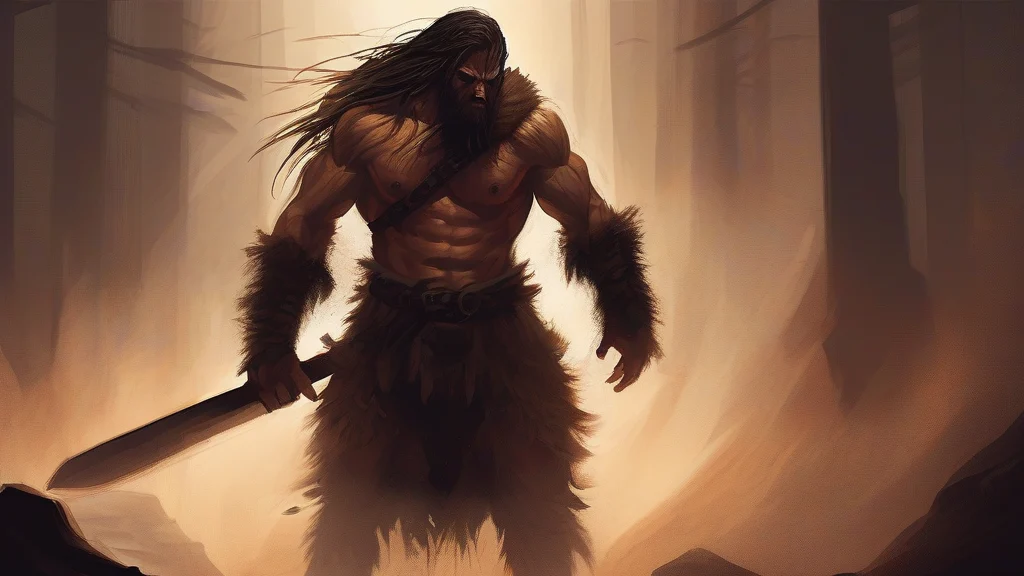
What does berserker mean?
A berserker was, in Old Norse tradition, a warrior of extraordinary ferocity who fought in a state of wild, seemingly unstoppable frenzy. The name comes from the Old Norse berserkr, most commonly explained as either 'bear-shirt' — suggesting fighters clad in bearskins — or possibly 'bare-shirt,' implying they went into battle without armor. Sagas describe berserkers howling, gnawing their shields, and showing superhuman strength while feeling no pain, though medieval sources are part history and part legend, making it hard to separate fact from myth. Today the word lives on both as a term for these legendary figures and, more loosely, for anyone who acts with violent, reckless abandon. It also gave English the adjective 'berserk,' as in the phrase 'to go berserk.' With its vivid imagery of untamed battle rage, 'berserker' remains a favorite of historians, novelists, and game designers alike.
nounA berserker is a warrior in Old Norse legend and history reputed to have fought with frenzied, uncontrollable fury, often said to have worked himself into a trance-like battle rage. By extension, it refers to any person who behaves with wild, violent, or reckless abandon.
- (historical, Scandinavian) One of a class of Viking-age warriors who fought in an ecstatic fury, associated with wearing bearskin shirts or entering a trance-like rage before battle.
- Any person who fights or behaves with wild, uncontrolled violence or recklessness.
"According to the sagas, the king's elite guard included a dozen berserkers who fought without armor and feared neither fire nor blade."
"In Norse saga literature, the berserkers were said to howl like animals and bite their shields before charging into combat."
"When the alarm sounded, he tore through the gym like a berserker, knocking over everything in his path."
Standard plural; occasionally seen as 'berserks' following the older Scandinavian form, especially in scholarly writing on Norse literature.
"The sagas tell of bands of berserkers who served as shock troops for Norse kings."
The name likely means either 'bear-shirt' or 'bare-shirt' — warriors so fierce they wore bearskins, or fought without armor at all.
Reviewed by Deb Chak, Editor. AI-assisted content curated by RJS Tech Solutions LLP.
Etymology of berserker
"Berserker" derives from the Old Norse berserkr, a compound usually interpreted as ber- (meaning 'bear') plus serkr ('shirt'), though some scholars argue ber- here meant 'bare,' yielding 'bare-shirt' — a reference to fighting without armor. The term entered English in the early nineteenth century through antiquarian writing about Scandinavian history, alongside the adjective 'berserk.' The element serkr survives in English 'shirt' and in the Scots and Northern English dialect word 'sark,' making these distant cognates within the Germanic family.
Related word forms
How berserker is actually used
The plural may be written "berserkers" or, reflecting Scandinavian orthography, "berserks"; the standard modern English plural is "berserkers." The word carries strong connotations of uncontrolled savagery and is mostly used in historical, literary, fantasy, or figurative contexts rather than everyday speech. In casual use it can sound slightly dramatic or playful.
Easily confused with berserker
"Berserk" is an adjective (or adverb) describing frenzied behavior — as in "he went berserk" — while "berserker" is the noun naming the frenzied warrior or person himself.