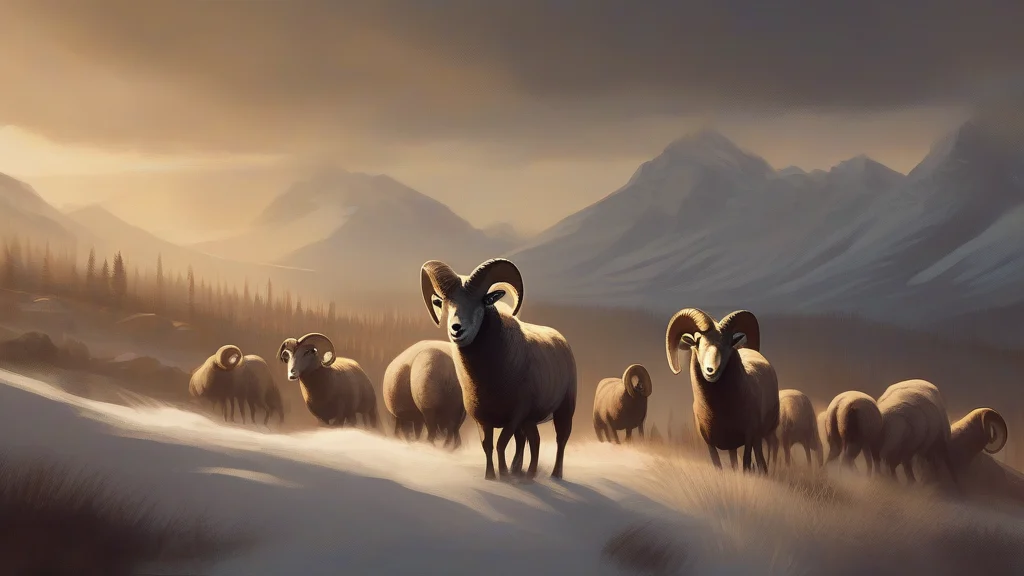
What does bighorn mean?
The bighorn is a large wild sheep native to the mountainous regions of western North America, scientifically known as Ovis canadensis. Its name comes from the enormous, spirally curved horns borne by mature rams, which can weigh up to around fourteen kilograms and are used in dramatic head-butting contests to establish dominance. Bighorns are renowned for their extraordinary agility, balancing on narrow cliff ledges that would defeat most predators. In everyday English the word functions as a noun and usually appears with "sheep" — as in "bighorn sheep" — though "bighorn" alone is common among hikers, hunters, and naturalists. The plural is typically unchanged, so one speaks of "a herd of bighorn." Beyond zoology, "bighorn" also names places such as the Bighorn River and Bighorn Mountains in Montana and Wyoming, reflecting how deeply the animal is woven into the identity of the American West. The word evokes wilderness, strength, and endurance, and remains firmly associated with conservation success stories, since bighorn populations recovered from near-extinction in the early twentieth century through dedicated protection efforts.
A large wild North American sheep (Ovis canadensis) inhabiting mountainous terrain, noted for the massive spirally curved horns of the male.
"A bighorn can scale near-vertical rock faces that would be impossible for most predators."
Often used attributively before "sheep" (as "bighorn sheep"); the plural is commonly unchanged.
The horn of a bighorn, especially as a material or object made from it.
"The museum displayed a bow reinforced with strips of bighorn."
Less common sense, found mainly in historical or ethnographic contexts.
When referring collectively to the animals, the plural is usually unchanged: "a herd of fifty bighorn." The form "bighorns" appears chiefly when counting individual animals.
"We counted nearly forty bighorn along the ridge at dawn."
A bighorn ram's skull can absorb impacts of over 1,000 newtons during head-butting contests — and the animal was named for the enormous horns that make this possible.
Reviewed by Deb Chak, Editor. AI-assisted content curated by RJS Tech Solutions LLP.
Etymology of bighorn
The word "bighorn" is a straightforward English compound formed from "big" and "horn," coined in North America in the late eighteenth century by fur traders and explorers who encountered the animal's strikingly large horns. It arose as a descriptive vernacular name alongside terms like "mountain sheep" rather than descending from any classical root. Its only true cognates are other compounds built on the native Germanic word "horn," which itself traces back to Proto-Germanic *hurną and ultimately the Indo-European root *ḱer-, meaning horn or head.
How bighorn is actually used
In everyday usage "bighorn" almost always refers to the animal, and it is frequently expanded to "bighorn sheep" for clarity. The plural is unchanged: "a herd of bighorn." The term carries connotations of rugged wilderness and is strongly associated with the Rocky Mountains and the American West.
Easily confused with bighorn
"Bighorn" is one word referring to the animal (or its horn), while "big horn" as two words is simply a descriptive phrase meaning a large horn.
The Dall sheep is a different North American wild sheep with pale coats and thinner, less curled horns than the bighorn.