
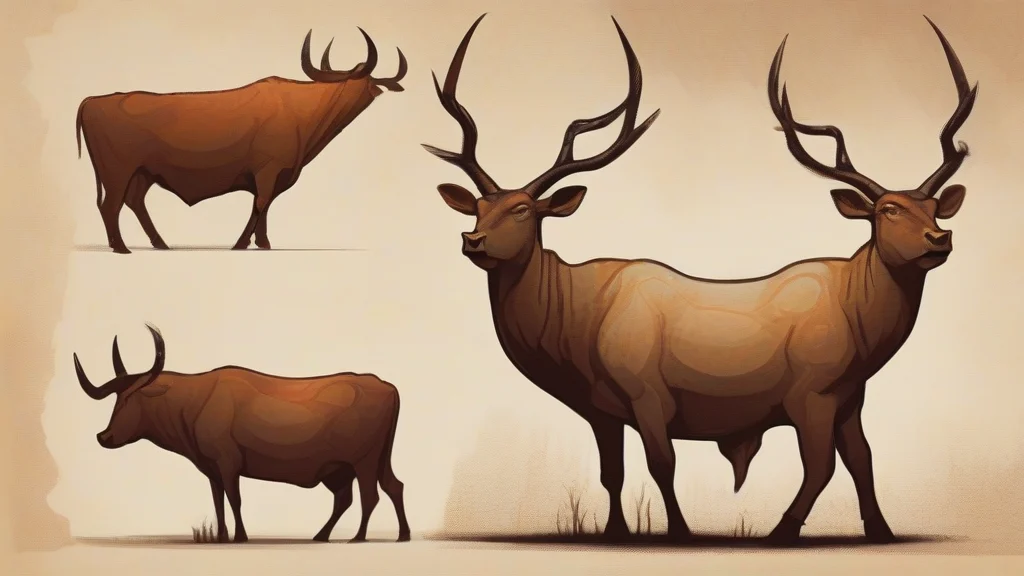
What does horned mean?
“Horned” is an adjective meaning that something has horns, particularly the permanent bony or keratin-covered structures of animals such as cattle, goats, and rhinoceroses. It can also refer to objects or forms with horn-like projections and is used figuratively in stories, religious imagery, and mythology. In ordinary biological writing, the term is straightforward and descriptive: a horned dinosaur or a horned toad is simply an animal with horns. The word belongs to a familiar semantic group that includes “horn,” “hornbill,” and “horner,” all reflecting the older English word “horn.” Although “horned” is sometimes confused with “horny,” their modern uses are distinct: “horned” describes the presence of horns, whereas “horny” commonly has a sexual meaning in informal speech. “Hornless” and “unhorned” provide straightforward antonyms when the opposite meaning is needed.
Having horns or a horn-like projection.
"A horned dinosaur skeleton dominates the entrance hall."
This is the ordinary descriptive use and is neutral in tone.
Portrayed or characterized as having horns, especially in literature, mythology, or religious imagery.
"The story depicts a horned figure who appears only at midnight."
This figurative use is common in literary, mythological, and cultural contexts.
From cattle and goats to dinosaurs, rhinos, and even the legendary Devil, horns have made “horned” one of English’s most vivid ways to describe a distinctive outline.
Reviewed by Deb Chak, Editor. AI-assisted content curated by RJS Tech Solutions LLP.
Where does horned come from?
The adjective “horned” was formed in English by adding the suffix “-ed” to “horn,” a word inherited from Old English and ultimately related to Latin “cornu.” The base word has long referred both to animal horns and to curved or pointed objects. The same root appears in compounds such as “hornbill,” while “horner” is an agent noun derived from the same base. Historically, “horned” could describe not only animals but also people marked in literary or religious contexts by symbolic horns.
How horned is actually used
In straightforward descriptions, “horned” is a neutral descriptive adjective. In literary, religious, or mythological contexts, it can carry symbolic associations with stubbornness, devilishness, or divine punishment. When referring to an animal, “horned” is more general than “antlered,” which usually suggests a deer or related animal.
Easily confused with horned
“Horn” is the noun naming the growth or projection, whereas “horned” is the adjective describing something that has one.
“Horned” means having horns, while “horny” usually means sexually aroused in informal modern usage and can also mean hard or horny in a literal material sense.