
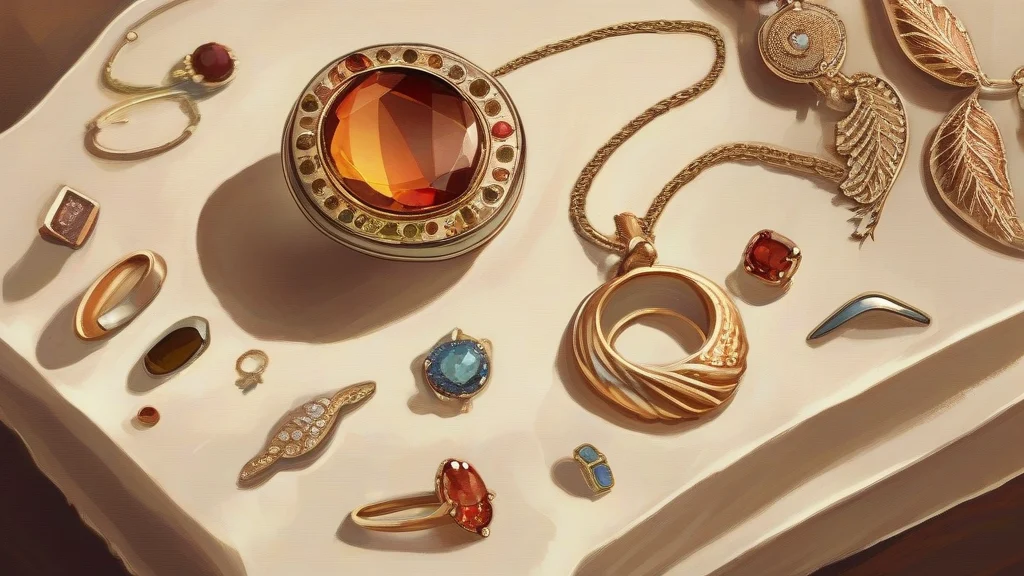
What does bijouterie mean?
Bijouterie is an English noun borrowed directly from French that means jewellery — particularly decorative or ornamental pieces such as brooches, bracelets, rings, and trinkets. While it can refer to fine jewellery, in modern usage it frequently denotes fashionable costume jewellery: attractive adornments whose charm lies in design rather than in the intrinsic value of their materials. The word functions as a collective term, much like 'jewellery' itself, and is normally used without a plural. Its French origin lends it an air of elegance, which explains why it appears most often in fashion journalism, auction house catalogues, museum exhibitions, and discussions of decorative arts history rather than in casual speech. Writers may reach for it to add refinement or a period flavour to a description, as in a reference to a duchess's collection of Art Nouveau bijouterie. For anyone interested in jewellery, antiques, or style writing, it is a useful and distinctive alternative to plainer terms.
nounJewellery, especially decorative or ornamental jewellery such as brooches, rings, and trinkets; in modern usage often applied to fine costume jewellery rather than precious pieces.
- Jewellery or ornamental personal adornment in general, especially decorative pieces such as brooches, bracelets, and trinkets.
- In the jewellery trade, specifically fine or fashionable costume jewellery as distinct from pieces set with precious stones.
"Her collection of vintage bijouterie included enamel brooches from the Art Nouveau era."
"The museum's exhibition traced a century of European bijouterie, from Victorian lockets to sleek modernist cuffs."
"She wore only a touch of bijouterie — a single pearl pin at her collar."
Rarely used; the word is almost always uncountable. A plural appears mainly when distinguishing several collections, styles, or classes of jewellery.
"The catalogue surveyed the bijouteries of three royal courts."
Borrowed wholesale from French, 'bijouterie' lets English speakers describe an entire drawerful of jewels with one glamorous word.
Reviewed by Deb Chak, Editor. AI-assisted content curated by RJS Tech Solutions LLP.
Etymology of bijouterie
Bijouterie comes directly from French, where it means both jewellery and the jeweller's craft. It derives from 'bijou', meaning a small jewel or trinket, a word whose ultimate origins are debated but which is often linked to Breton 'bizou' (ring) from 'biz' (finger). The word entered English in the nineteenth century, retaining its French spelling and pronunciation, and remains a somewhat literary borrowing compared with native 'jewellery'.
How bijouterie is actually used
The word is uncountable in ordinary use, though a plural form appears occasionally when referring to multiple collections or categories of jewels. It carries a slightly elevated, French-inflected tone, so it tends to appear in fashion writing, auction catalogues, and art-historical contexts rather than everyday conversation. In the French jewellery trade it can also mean the craft or business of jewellery-making, but this sense is rare in English.
Easily confused with bijouterie
A 'bijou' is a single small jewel or trinket (or, figuratively, something small and elegant), whereas 'bijouterie' is a collective term for jewellery as ornamentation.
'Joallerie' refers specifically to fine jewellery made with precious stones and metals, while 'bijouterie' often denotes ornamental or costume jewellery.